Opening a Thai Bank Account as a Foreigner (2026)

On this page
- Which residency status actually gets an account in 2026
- Table 1 - Residency category vs. reported 2026 personal-account eligibility
- Eligibility decision tree
- Why a valid long-stay visa still gets rejected
- Same bank, different branch, different answer
- The documents banks actually ask for
- Tiered document checklist
- The address-proof problem nobody sequences for you
- What the account costs to open and to keep
- If the answer is still no: living without a Thai account
- Frequently asked questions
- Where to go next
- Sources
Nobody gets turned down at a Thai bank for having too little money.
They get turned down for holding the wrong kind of permission to be here, and they find that out standing at a counter with a folder of documents that were never the problem.
Your immigration category decides this. Your savings do not, your choice of bank barely does, and since 2024 the list of categories that clear the check has narrowed.
One thing up front, because it changes how you should use this page: the 2026 eligibility pattern below is reported consistently across several independent commercial sources.
It is not a published Bank of Thailand rule I was able to read. It shifts, and it varies from branch to branch on the same day.
This article is not financial, legal, tax or immigration advice. The 2026 eligibility pattern described here is reported by cross-corroborated commercial sources, not by a published Bank of Thailand text we were able to read - treat it as a strongly reported pattern subject to change, and confirm with the specific branch before you make a trip or a move depend on it. Approval varies by branch and by staff even within one bank, so a single rejection is not proof the route is closed everywhere. All deposit, balance and fee figures here are indicative snapshots and must be confirmed with the bank before you act on them. Visa and residency category names appear only as labels a bank's compliance check looks for; their fees, validity periods and application mechanics are out of scope.
Current as of 11 August 2026.
Which residency status actually gets an account in 2026
The sources that cover this describe the same split across the major retail banks: Bangkok Bank, Kasikorn (KBank), SCB, Krungsri and UOB. On one side, long-stay categories with something anchoring you to Thailand - an employer, a retirement extension, a program membership. On the other, tourist entry stamps and the DTV, both reported as turned away for new personal accounts.
The DTV rejection is the part that surprises people, and the mechanism the sources give is worth understanding rather than just memorizing. A bank's know-your-customer process is not asking how long your visa is valid for. It is asking who on the Thai side vouches for you.
The DTV has no sponsor built into it - no employer, no school, no Thai institution attached to the grant - so compliance screening treats it much the way it treats a tourist visa.
Years of validity, none of the anchoring. (If you want the visa's own terms rather than the banking consequence, that is a different page: what the DTV actually is, and what it costs.)
I list those five banks as the set the pattern was observed across. Not as a ranking, and not as a promise about any one of them.
Table 1 - Residency category vs. reported 2026 personal-account eligibility
| Residency / visa category | Reported 2026 outcome for a NEW personal account | What the bank is looking for | Source strength |
|---|---|---|---|
| Non-B with work permit | Generally accepted | Employer sponsorship, backed by an employer letter | Commercial sources, cross-corroborated (reported) |
| Non-O / O-A / O-X | Generally accepted | A long-stay category with a Thai-side anchor, plus proof of Thai address | Commercial sources, cross-corroborated (reported) |
| LTR | Accepted | BOI Certified Consideration Certificate, via the Kasikorn route | Official source (Thailand Board of Investment) |
| Thailand Privilege ("Elite") | Accepted via the program's partner-bank track | Membership-backed assistance through partner banks | Program's own commercial page (reported) |
| DTV (what the DTV actually is) | Reported as rejected at the major banks | No Thai-side sponsor; treated like a tourist visa by compliance screening | Commercial sources, cross-corroborated (reported) |
| Tourist entry stamp / visa exempt | Reported as rejected | Same compliance reasoning; the older discretionary path appears likely superseded, though not confirmably closed | Commercial sources, contested (reported) |
That fourth column is the point of the table. Only one row rests on an official document.
Eligibility decision tree
Start with the honest version of the question: what permission are you actually holding in your passport right now, today?
- Non-B with a work permit → standard long-stay route. Bring the employer letter. Your HR department has usually done this before, which is worth more than any branch tip.
- Non-O, O-A or O-X → standard long-stay route. The binding constraint here is almost never the visa. It is the address proof, so read that section before you go.
- LTR → the Kasikorn route with the BOI Certified Consideration Certificate. This is the one path on this page with an official source behind it, so follow the BOI's own instructions over anything I write.
- Thailand Privilege member → the partner-bank assisted track through the Member Contact Center. Use the membership you paid for; that is what the contact center is for.
- DTV → reported as rejected at the major banks. Read the fallback section below before you spend a morning queueing.
- Tourist stamp or visa exempt → reported as rejected. Same advice as the DTV row, with the added note that the old discretionary route is neither promised nor confirmed dead.
- Not sure which category you hold → find out first. The stamp page in your passport, not your understanding of what you applied for, is what the counter reads.
- Any tier, no Thai address proof yet → housing comes first in practice. Get your lease signed first - most banks want that address proof.
Every terminal node above ends in a document set and a caveat. None of them ends in a promise, because I cannot make one and neither can a forum thread.
Why a valid long-stay visa still gets rejected
Three separate things go wrong, and people tend to blend them into one grievance.
The first is category classification. A visa can be valid for years and still sit on the wrong side of the compliance line, because duration and sponsorship are different properties. The screening asks who backs you here; it does not award points for a long expiry date.
This is why "but my visa is good until 2028" is not an argument a counter can act on.
The second is the reason the ground moved at all. The tightening is attributed to the Bank of Thailand's customer-due-diligence and "mule account" directives across 2024-2026, aimed at accounts opened and then sold on to scam operations. I want to be precise about what I know here: I could not read the directive itself.
No primary Bank of Thailand text was available to me, so the driver is named in the commercial sources rather than quoted from the regulator. That is a meaningful gap and I am not going to paper over it.
I also have to correct my own advice.
For years I told people that a friendly branch would still open a basic savings account on a short-stay status if you turned up with enough paperwork, enough patience and a willingness to come back twice.
That was true when I said it. Older sources still describe that discretionary path as existing at individual branches; newer 2026 sources report near-universal rejection. The honest position is that it looks superseded rather than confirmed gone, and since I was the one handing out the old version, I will not smooth that over into either a promise or an obituary.
The third cause is dull and extremely common: the address proof is missing, or it is not in a form the branch accepts. That one gets its own section, because the sequencing is genuinely unsolved.
One rule carries more weight than everything above. A rejection is a branch-level outcome, produced by a specific counter on a specific day, and it is not a national verdict on your visa category.
Same bank, different branch, different answer
Two branches of the same bank gave me two different answers on the same visa, in the same week. Neither one was lying, exactly - that's just how this works now. The first branch declined in about ninety seconds and offered nothing else.
The second processed it and asked whether I wanted the mobile app set up.
My mistake was at the first branch: I accepted "no" and walked out without asking what specifically failed.
That is not information you can act on. "No" tells you nothing about whether the problem was the visa category, a document the officer could not read, or an internal rule that branch applies more strictly than its neighbors.
Now I ask, plainly, which item blocked the application, and I write down the answer before I leave the counter.
This variation is a documented pattern rather than a personal grudge.
The research behind this page records "same institution, different branch or office, different answer" as one of the most repeated frustrations across Thai banking, immigration offices and even school enrollment, because head-office policy is not applied uniformly at counter level.
Nobody has quantified it and I am not going to invent a number for you.
What that means in practice:
- Ask what specifically failed, and get it in concrete terms.
- Fix that item, then try a different branch rather than the same one on a different day.
- Prefer a branch that handles foreign applicants routinely. English-language service is reported strongest at the major BTS-adjacent Bangkok branches of Kasikorn and Bangkok Bank, with SCB described as broadly English-capable.
- Do not treat one forum post about one branch as national policy. That works in both directions, and the optimistic version has cost people flights.
The documents banks actually ask for
Commonly requested, depending on your category and the branch: your passport carrying the current qualifying visa, proof of a Thai address, a registered Thai mobile number, and a supporting or guarantee letter where your category calls for one.
One source specifies at least six months' remaining passport validity - that is single-sourced, so I treat it as a target to clear rather than a confirmed rule.
The supporting letter varies by route. An employer letter for Non-B holders. A school or embassy letter where the category calls for it.
For LTR holders going through Kasikorn, the BOI Certified Consideration Certificate, and that route is worth calling out because it is the only path here documented by an official primary source: the Thailand Board of Investment publishes the requirement itself.
Follow BOI's page over any blog, mine included.
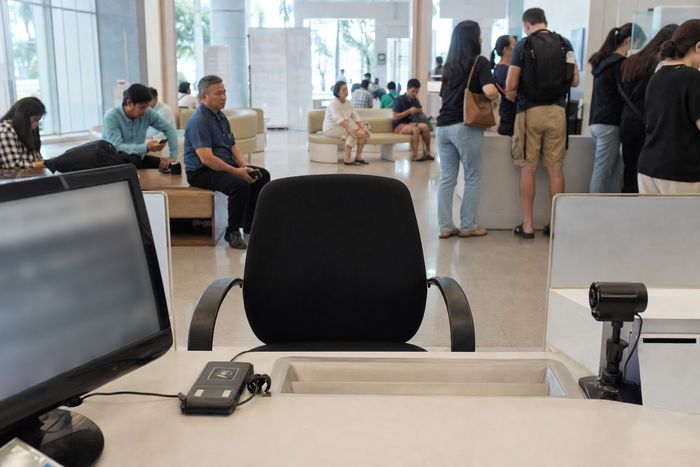
Since late 2025, in-person biometric verification is reported as mandatory - a face scan and a read of your passport chip - and remote or online account opening for foreigners as effectively phased out.
You have to be in the room for this part. Plan the branch visit; do not plan around it.
Tiered document checklist
Tier A - everyone, every category
- Passport with the current qualifying visa (aim for six or more months' remaining validity; that figure comes from a single source, so treat it as a target).
- The visa or entry stamp page itself, findable without flipping through the whole passport.
- Proof of Thai address: a lease, a utility bill, or a Certificate of Residence. Get your lease signed first - most banks want that address proof.
- A registered Thai mobile number.
- Cash for the initial deposit.
Tier B - by category
- Employer letter (Non-B with work permit).
- School or embassy letter, where your category calls for one.
- BOI Certified Consideration Certificate (LTR, via the Kasikorn route).
- Member Contact Center referral (Thailand Privilege).
Tier C - the practical layer
- Turn up in person for the biometric capture, keep a second branch on the shortlist for the same day, and photograph every document you hand over before you hand it over.
A complete file improves the odds that the application is judged on your category rather than on a gap. It does not bind a bank to approve you, and no checklist can.
The address-proof problem nobody sequences for you
Here is a gap I could not close from the sources, and I would rather name it than fake a workaround: none of the material behind this article explains how to open an account before you have secured long-term housing, when proof of a Thai address is a standard prerequisite for the account.
So the practical order is housing first. The lease is the address proof most readers end up using, with a utility bill or a Certificate of Residence as the other accepted forms.
If you are arriving into a hotel or a monthly rental with no paperwork in your name, expect the bank step to wait on the housing step, and plan your first few weeks accordingly: see where opening an account fits into the first-month sequence.
One assisted route exists around this friction, with a condition attached.
Thailand Privilege describes a partner-bank track through Kasikorn, Bangkok Bank, SCB and LH Bank, with a dedicated Member Contact Center and a processing time the program itself puts at around seven days.
That is the program's own description of its own service, and it is tied to a paid membership rather than open to anyone who walks in. Useful if you already hold the membership. Not a solution to buy for this alone.
What the account costs to open and to keep
| Item | Reported figure (2026) | What to confirm at the branch |
|---|---|---|
| Initial deposit | THB 500-1,000 at most banks, as reported in 2026 | The exact amount for the specific account product they open for you |
| Minimum balance | THB 2,000, common at SCB, Kasikorn and Bangkok Bank as reported in 2026 | Whether it applies to your account type, and from when |
| Inactivity fee | THB 50 per month below the minimum balance after 12 months, as reported in 2026 | The threshold, the timing, and whether the account can go dormant |
These are commercially sourced snapshots from 2026, which is why the third column exists. A branch can contradict all three, and the branch is the one holding your money.
None of them is decision-critical - nobody's relocation turns on THB 500 - but they are what you budget against, and the inactivity fee is the one that quietly eats an account you opened and then left alone for a year.
A separate friction, worth keeping separate: a large incoming transfer can trigger additional manual verification, independent of your residency status. That is not an eligibility problem, it is a transaction-monitoring problem, and it happens to people whose accounts were approved without a hitch. Do not read a held transfer as a sign that your category was the issue.
If the answer is still no: living without a Thai account
What works in the meantime is unglamorous and functional: a foreign debit or credit card for daily spending, plus a cross-border transfer app for moving money in. I ran that combination for stretches, and it covers more than people expect.
What you lose is PromptPay, Thailand's domestic instant transfer rail, and that is the real cost. PromptPay is how rent gets paid, how a bill gets settled, how the person who fixed your air conditioner expects to be paid before they leave. Without it you are the customer who needs an exception made, every time.
Which brings up the claim I want to kill outright. You do not need a Thai bank account to rent a home in Thailand. No source states it as a legal requirement, and the verdict on that claim is false.
Cash works. An international transfer works.
What is true is that landlords commonly prefer a Thai bank transfer or PromptPay, and some will push hard on that preference - but a preference is not a law, and knowing the difference is what lets you negotiate instead of assuming you are disqualified.
Being honest about the ceiling: this is a workable holding pattern, not an equivalent. If your category is reported as rejected right now, run the fallback, keep the paperwork you would need ready, and re-check when your status changes.
Frequently asked questions
They turned me down at one branch - is that it, or should I try somewhere else?
Try somewhere else. Branch discretion is a documented pattern, so one rejection is a branch-level outcome rather than a national verdict on your category. Ask what specifically failed, fix that item, then attempt a different branch, ideally one that handles foreign applicants routinely.
I'm on a DTV - can I open an account if I find the right branch?
Reported as rejected at all the major banks in 2026, because compliance screening treats the DTV like a tourist visa in the absence of a Thai-side sponsor. The older discretionary basic-savings path is likely superseded but not confirmably closed. Treat it as a long shot rather than a plan, and read the fallback section.
Which bank is easiest for foreigners to open an account with?
Wrong question, honestly. Eligibility is reported to depend on your residency category far more than on which bank you walk into, so the useful framing is "easiest by category", not by brand. English-language service is reported strongest at major Bangkok branches of Kasikorn and Bangkok Bank, with SCB broadly English-capable.
Do I need the lease before the bank, or can I do it the other way round?
In practice the lease comes first, because proof of Thai address is a standard prerequisite. No source I found explains how to run it in the opposite order, and I am not going to invent a sequence. The accepted alternatives are a utility bill or a Certificate of Residence.
Can I set this up online before I fly out?
Reported as no. In-person biometric verification has been described as mandatory since late 2025, and remote opening for foreigners as effectively phased out. Budget a branch visit into your first weeks here rather than expecting to arrive with the account already live.
How do I know the account is actually doing its job?
You can send and receive domestic transfers on PromptPay, you can pay rent and bills the way landlords and billers expect, and your balance sits above the reported minimum so the inactivity fee never comes into it.
If all three hold, the account is working.
Where to go next
Whichever tier you landed in, the next question is the order of everything else - housing, address proof, reporting, the account itself.
See where opening an account fits into the first-month sequence, or head back to living long-term in Thailand for the rest of the cluster.
Sources
- Thailand Board of Investment (BOI), LTR visa program (official) - the LTR route: Kasikorn Bank documentation and the BOI Certified Consideration Certificate, the only officially sourced banking path on this page. ltr.boi.go.th, current at retrieval, 2026.
- Statrys, "Best banks for foreigners in Thailand" (commercial) - the 2026 visa-status gate, the set of major banks, and the English-language service observations. 2026.
- A Bangkok advisory firm's 2026 guidance (MBMG Group, commercial) - second independent corroboration of the visa-status gate and the DTV and tourist rejection pattern. 2026.
- Thailand Privilege, bank-account page (commercial, the program's own) - the partner-bank assisted track (Kasikorn, Bangkok Bank, SCB, LH Bank), Member Contact Center, and the roughly seven-day processing time. 2026.
- Bank of Thailand customer-due-diligence and "mule account" directives, 2024-2026 (not captured) - named here as the underlying driver of the tightening; no primary text was available to us, and nothing on this page quotes the directive itself.
- Each bank's own official site (Bangkok Bank, Kasikorn, SCB, Krungsri, UOB) - the only authoritative statement of that bank's current account-opening terms, and your verification step rather than a source quoted here.
Nothing here is financial, legal, tax or immigration advice. The 2026 eligibility pattern on this page is reported by cross-corroborated commercial sources and not by any published Bank of Thailand text I was able to read, so it can change and it does vary by branch and by staff within a single bank - one rejection is not proof a route is closed everywhere, and no bank or branch can be said in advance to accept or refuse any given visa category. Every deposit, balance and fee figure is an indicative 2026 snapshot to confirm with the bank before you act. Bank visa-acceptance policy has changed several times across 2025-2026; check the "current as of" date above and verify anything your trip or your money depends on directly with the branch.
