Where to Stay in Thailand: How to Pick the Right District, Not Just the Right City
A catalog of 72 named lodging areas across ten Thai destinations, with one clear method for choosing among them. It is for travelers who have booked the flight and now need to choose between two beaches or sois that look identical on a booking site.
Start with the District Finder below. Pick a destination, then filter by the five criteria. If you are still comparing similar areas, read the choosing method first.
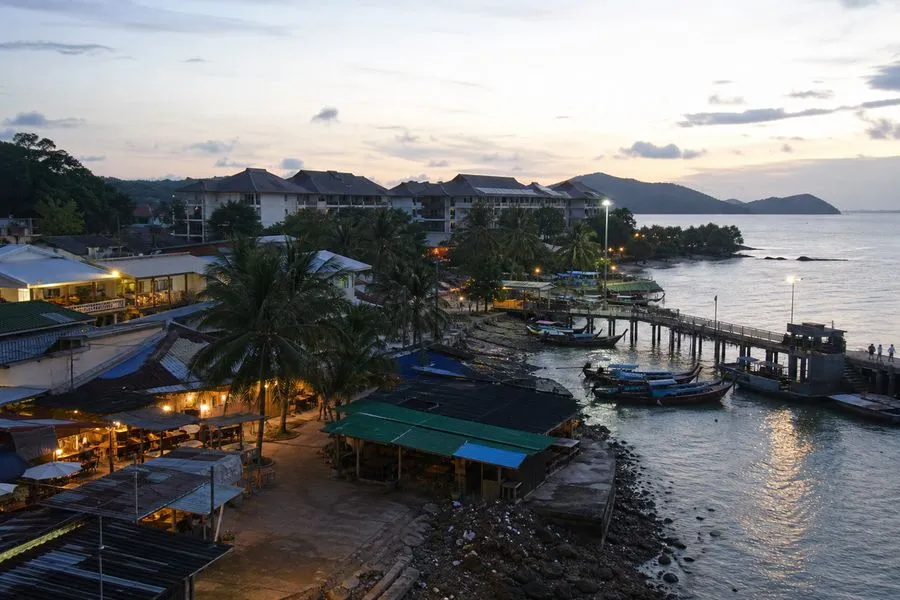
"Where to stay in Thailand" is two decisions stacked on top of each other
First, choose a destination based on the trip you want and how much time you are willing to spend in transit.
Then choose an area within that destination based on daily life: what you will hear at 2 a.m., how far you will walk to dinner, whether a stroller will fit on the sidewalk, and whether reaching the airport requires a boat.
Most lodging disappointment in Thailand comes from the second decision. Nobody regrets Phuket in the abstract. People regret booking the busy south coast when they wanted the quieter north, or choosing a beautiful bay where they cannot swim.
Our destination guides cover the first decision. This hub covers the second, while the homepage connects both choices with visa, flight, and seasonal planning.
The areas below are not administrative districts. They are market names with soft, disputed boundaries, sometimes shaped by hotel marketing. That looseness causes many of the booking mistakes covered here.
A recurring pattern across Thai destinations
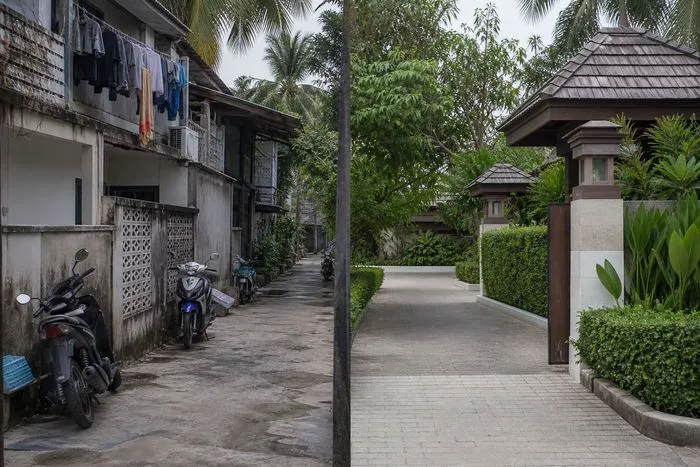
Many Thai destinations contain a budget or backpacker strip that developed early and remained cheap and loud, a newer resort belt built for package or upmarket stays, and an old town or pier town that works mainly as a local-life and logistics base.
This is a pattern compiled from our source corpus, not a verified rule for every destination, so check it against current local conditions.
The budget-strip role appears in Khao San Road in Bangkok and Haad Rin on Ko Phangan.
Resort belts include Bang Tao, with its gated Laguna estate, and the Klong Muang and Tubkaek stretch north of Ao Nang.
Logistics bases include Phuket Town, Krabi Town, Thong Sala, Mae Haad, and Saladan.
The pattern also explains some price differences. A 900-baht room in a pier town may be cheap because the town serves travelers in transit and offers practical basics such as a market and 7-Eleven. A 900-baht room in a resort belt may sit 700 meters behind the properties occupying the beach frontage.

The five criteria, and the District Finder
Every page in this catalog uses the same five criteria:
- Nightlife and noise intensity. This is a decibel forecast, not a moral judgment. Check whether the noise is limited to one named street that you can avoid by staying two blocks away, or whether it defines the whole area.
- Family suitability. Look at sidewalks, shade, room configurations, and especially the water. Swimming conditions can differ sharply between neighboring beaches.
- Budget tier. Treat this as a range. The spread within one area can be wider than the gap between two areas.
- Walkability and transit access. In Bangkok, this can outweigh every other criterion. The BTS Skytrain's Sukhumvit and Silom lines opened in December 1999 and, together with the MRT, still shape lodging value. An area near an interchange such as Siam or Asok works differently from a taxi-only address at the same nightly rate.
- Long-stay and remote-work fit. Consider monthly rather than nightly costs, then check the practical inputs: a kitchen, laundry, a desk, and a cafe that tolerates a four-hour stay.
The District Finder applies those filters within your chosen destination. You can use it to find, for instance, Ko Samui areas that are quiet, suitable for families, and mid-tier. Treat the result as a shortlist, then read the two or three matching pages.
The tradeoff that decides a booking usually appears in the details.
For accommodation costs, see our money and costs guide. For transport, see getting around.
Look-alike areas: the mistake this catalog exists to prevent
A common booking error is choosing an area that shares a name, beach, or road with the place you actually wanted. Some pairs are separate places. Others are two labels for the same place, or one area nested inside another.
| If you are weighing | You probably want | Because |
|---|---|---|
| Sukhumvit against Phrom Phong, Thonglor, Ekkamai | The specific soi range, not the road | These are four slices of one corridor: Sukhumvit here means Soi 3-21 (Nana to Asok), Phrom Phong Soi 39-53, Thonglor Soi 55, Ekkamai Soi 63. Character shifts every few hundred meters. |
| Night Bazaar against Chang Klan | Either; they are the same strip | Two publisher labels for Chang Klan Road. One angle is the nightly market, the other the hotel corridor. Booking both is booking the same place twice. |
| Bang Tao against Laguna | Open beach town or gated estate | Laguna is a resort and golf estate built on Bang Tao's southern section. Inside it you are in a curated, self-contained village; outside it you are in a connected beach town. |
| Bophut against Fisherman's Village | Bophut, if you mean the area | Fisherman's Village is the restored shophouse walking street inside Bophut, not a separate coast. Choose Bophut for the stay, walk to the village for dinner. |
| Chinatown against Yaowarat | Chinatown for lodging | Yaowarat is Chinatown's commercial spine road and its food identity. The wider district is where the rooms are. |
| Cha Am against Hua Hin Town | Check which town the property is in | These are separate towns roughly 30-40 minutes apart by road, yet several "Hua Hin"-branded resorts carry Cha Am location tags on Booking.com and trivago. The brand name is not the address. |
| Klong Muang against Tubkaek | Middle ground or farther out | Klong Muang is the sourced compromise on the Krabi mainland's north coast; Tubkaek sits more remote and higher-end, with a national-park waterfall trail Klong Muang does not have. |
| Nai Yang against Mai Khao | Budget-quiet or luxury-secluded | Both are Sirinat National Park beaches near the airport. Nai Yang reads quieter and more local with budget stock; Mai Khao is longer, more secluded, and effectively luxury-only. |
| Lipa Noi against Taling Ngam | Honestly, either | Our sources do not support a sharp distinction. One treats them as equally quiet and undeveloped. The softest sourced difference: Lipa Noi is bungalow-scale, Taling Ngam is dominated by one large anchor resort and sits closer to the Raja Ferry pier. |
Red flags that a listing is not in the area you think it is. Check these before paying:
- The area name appears in the property's name but not in its street address.
- The map pin sits outside the area you searched, while the listing explains the gap with a phrase such as "just minutes from."
- Results for a small area are dominated by properties whose descriptions name a larger neighbor. Searches around Ao Nam Mao return Ao Nang and Railay stock this way. One aggregator page about "Ao Nammao Bay" even served villas tagged to Koh Lanta, a different island.
- The listing advertises a "private beach." Private beach ownership is not permitted in Thailand, so a resort-fronted beach remains legally public. Some function as effectively private anyway, including a reported case on Phuket's Pansea Beach where a public walking trail had been fenced off as of a 2019 source visit.
- A roadless area has no stated transfer method, or the listing gives one tidy transfer time even though the crossing depends on weather.
What the sources support, and what they do not
The evidence behind Thai lodging-area guides is uneven, including the evidence behind this one. Of roughly 150 facts extracted for these 72 areas, exactly two came from an official government or tourism-authority source. One was a Tourism Authority of Thailand page describing Phuket's crowded south coast, quieter north, and beaches offering watersports instruction.
The other was the Koh Tao Tourism Association's confirmation of seaside hotels on both sides of the Mae Haad pier.
For Bangkok, Chiang Mai, Krabi, Ko Samui, Ko Phangan, Pattaya, Hua Hin, and Ko Lanta, no official source surfaced in the corpus. Nor did the corpus produce a Thai regulator, licensing register, short-term-rental authority, hotel-classification body, or lodging complaints process.
Neighborhood character rarely has one official custodian. The available evidence instead comes from Booking.com, Agoda, Expedia, Trip.com, Hotels.com, trivago, Klook, hotel marketing sites, and independent guides of varying quality. We corroborate claims across independent sources when possible.
Aggregator geotags remain claims rather than facts because we caught them wrong twice in this batch.
Price figures need the same caution. As of 2026, single-source figures suggest that Phuket ranges from around 250 baht a night in Phuket Town to tens of thousands of baht along the Bang Tao and Layan belt. Ko Phangan sits roughly in the 250-3,000 baht range, depending on the area.
Mae Haad hostel beds are reported at around 200-300 baht per person.
For monthly stays, one-bedroom rentals in Chiang Mai's Nimman were quoted at roughly 15,000-28,000 baht. Santitham was reported at 40-50% less for comparable space, while studios in Bangkok's Ratchada started at about 10,000 baht.
Treat all those figures as directional, undated, and in need of a fresh check. They can help rank areas against one another, but they are not reliable enough for a final budget.
Risk, access, and when to find something fresher
Three issues can change the booking decision.
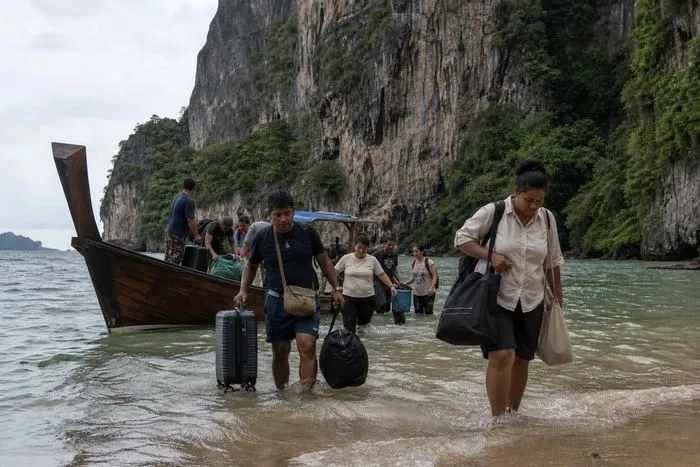
Boat-only areas have no road connection. Railay is the clearest example, and its transfers depend on the weather. Build in a buffer day before an onward flight.
Swimming conditions also vary within a destination. Rawai carries a no-swimming note even though beaches a short drive away are suitable for swimming. If the water matters, verify the current conditions at the specific beach rather than relying on the destination's general reputation.
Noise depends on containment.
A single entertainment street within a large district, as in Silom, affects a smaller radius than a strip such as Patong, where nightlife shapes the wider area.
Find a newer source if a safety or nightlife description is more than a year or two old, if you are assessing a beach for children, or if one blog makes an unnamed superlative claim. Use official government travel advisories for current conditions.
Seasonal timing, particularly the difference between the Gulf and Andaman coasts, can remove an area from consideration altogether; see our when to go guide.
Browse the full index
Grouped by parent destination. Nested and paired areas are shown indented under the area that contains them.
Bangkok
- Sukhumvit: Where to Stay Guide (Bangkok) - Lower Sukhumvit only, Soi 3-21 from Nana to Asok: the densest hotel supply on the BTS spine.
- Phrom Phong: Where to Stay Guide (Bangkok) - Soi 39-53, mall-anchored and the easiest stretch of the corridor with kids.
- Thonglor: Where to Stay Guide (Bangkok) - Soi 55, skewed toward dining and late-night venues.
- Ekkamai: Where to Stay Guide (Bangkok) - Soi 63, the calmer residential end of the same corridor.
- Siam, Bangkok: Shopping & Transit Hub Guide (2026) - The historic BTS interchange between the Sukhumvit and Silom lines, wrapped in malls.
- Silom: Where to Stay Guide (Bangkok) - Business district by day with a contained entertainment sub-strip by night.
- Sathorn: Where to Stay Guide (Bangkok) - Embassy and office quarter, quiet after dark.
- Riverside: Where to Stay Guide (Bangkok) - Chao Phraya hotels where the boat replaces the taxi.
- Chinatown: Where to Stay Guide (Bangkok) - Heritage district framing for the whole quarter, including where the rooms are.
- Yaowarat: Where to Stay Guide (Bangkok) - Chinatown's commercial spine road and its street-food and gold-trade identity.
- Banglamphu: Where to Stay Guide (Bangkok) - The old-town quarter around the backpacker strip, within walking distance of the temple core.
- Khao San Road: Where to Stay Guide (Bangkok) - The original budget strip, loud by design and off the rail network.
- Ari: Where to Stay Guide (Bangkok) - Leafy off-corridor neighborhood on the BTS Sukhumvit line, cafe-heavy.
- Victory Monument: Where to Stay Guide (Bangkok) - Transit-junction base north of Siam, priced below the corridor.
- On Nut: Where to Stay Guide (Bangkok) - Outer BTS value zone with condo stock aimed at longer stays.
- Ratchada: Where to Stay Guide (Bangkok) - MRT-side night-market and nightlife corridor; verified hotel evidence is thin, with only one property named across our sources.
Chiang Mai
- Old City: Where to Stay Guide (Chiang Mai) - The moated historic core, walkable between temples.
- Nimman: Where to Stay Guide (Chiang Mai) - Cafe and coworking zone; mid-range hotels reported 15-25% above Old City rates.
- Chang Klan, Chiang Mai: Where to Stay (2026) - The hotel corridor along Chang Klan Road, read from the accommodation side.
- Night Bazaar: Where to Stay Guide (Chiang Mai) - The same strip, read from the nightly market side.
- Santitham: Where to Stay Guide (Chiang Mai) - Local residential pocket where rents are reported 40-50% below comparable Nimman space.
- Wat Ket: Where to Stay Guide (Chiang Mai) - East bank of the Ping River, quieter than the moat.
- Hang Dong: Where to Stay Guide (Chiang Mai) - Southern semi-rural belt, villa and long-stay leaning, car-dependent.
- Mae Rim: Where to Stay Guide (Chiang Mai) - Northern valley resorts and monthly rentals starting around 12,000 baht.
Phuket
- Patong: Where to Stay Guide (Phuket) - The island's main nightlife strip and its widest price spread.
- Karon: Where to Stay Guide (Phuket) - Long west-coast beach next door to Patong, calmer and more package-oriented.
- Kata: Where to Stay Guide (Phuket) - Surf-season beach with a compact walkable center.
- Kamala: Where to Stay Guide (Phuket) - Quieter northern west-coast bay, mid to upper tier.
- Surin: Where to Stay Guide (Phuket) - Small upmarket beach between Kamala and Bang Tao.
- Bang Tao: Where to Stay Guide (Phuket) - Long purpose-built resort belt with an open, connected beach-town side.
- Laguna Phuket: Resort Estate Guide (Inside Bang Tao) - The gated resort and golf estate on Bang Tao's southern section.
- Nai Harn: Where to Stay Guide (Phuket) - Southern bay with a local feel and a swimmable beach.
- Rawai, Phuket: Where to Stay Guide (No Swimming Beach) - Long-stay and expat base on the south coast where the beach is for boats, not swimming.
- Chalong, Phuket: Pier & Boat-Base Guide (2026) - Pier town and dive-boat departure point rather than a beach stay.
- Cape Panwa: Where to Stay Guide (Phuket) - Secluded southeastern headland with a wide budget-to-luxury range.
- Phuket Town: Where to Stay Guide (Phuket) - Sino-Portuguese old town and the island's cheapest tier, from around 250 baht.
- Nai Yang: Where to Stay Guide (Phuket) - Sirinat National Park beach near the airport, quieter and more local, with budget stock.
- Mai Khao: Where to Stay Guide (Phuket) - The longer, more secluded park beach, effectively luxury-only.
Ko Samui
- Chaweng: Where to Stay Guide (Ko Samui) - The island's main beach and nightlife concentration.
- Lamai: Where to Stay Guide (Ko Samui) - Second-busiest beach, a step down in intensity from Chaweng.
- Bophut: Where to Stay Guide (Ko Samui) - Quiet boutique north-coast identity, convenient to the airport.
- Fisherman's Village, Bophut: Walking-Street Guide - The restored shophouse walking street and night market inside Bophut.
- Choeng Mon: Where to Stay Guide (Ko Samui) - Sheltered northeast cove that suits families.
- Maenam: Where to Stay Guide (Ko Samui) - Low-key north coast with a long-stay following.
- Bang Po: Where to Stay Guide (Ko Samui) - Quiet northwest strip known for its seafood row.
- Lipa Noi: Where to Stay Guide (Ko Samui) - Undeveloped west coast at bungalow scale, near the ferry side.
- Taling Ngam: Where to Stay Guide (Ko Samui) - Equally quiet southwest coast, dominated by one large anchor resort.
Krabi
- Ao Nang: Where to Stay Guide (Krabi) - The mainland hub with the most rooms, restaurants, and boat connections.
- Railay: Where to Stay Guide (Krabi) - Boat-access-only peninsula between limestone cliffs.
- Klong Muang: Where to Stay Guide (Krabi) - The sourced middle ground on the quieter north coast.
- Tubkaek: Where to Stay Guide (Krabi) - More remote and higher-end, with a national-park waterfall trail nearby.
- Krabi Town: Where to Stay Guide (Krabi) - River town that works as a transit and budget base, not a beach stay.
- Ao Nam Mao: Where to Stay Guide (Krabi) - Quiet cove and boat pier with only three properties confirmed geotagged to it.
Ko Phangan
- Thong Sala: Where to Stay Guide (Ko Phangan) - Ferry-pier town, the island's logistics and errands base.
- Haad Rin: Where to Stay Guide (Ko Phangan) - The party beach, roughly 250-2,000 baht from dorms to private rooms.
- Srithanu: Where to Stay Guide (Ko Phangan) - Wellness and yoga west coast, about 500-3,000 baht.
- Baan Tai: Where to Stay Guide (Ko Phangan) - South-coast strip between the pier and the party beach, similar price band.
- Thong Nai Pan: Where to Stay Guide (Ko Phangan) - Northeast bays reached by rough road, simple rooms through boutique resorts.
- Chaloklum: Where to Stay Guide (Ko Phangan) - Working fishing village on the north coast.
Pattaya
- Central Pattaya: Where to Stay Guide (Pattaya) - Beach Road and the nightlife core, highest density and highest noise.
- Jomtien: Where to Stay Guide (Pattaya) - Longer beach south of the center, family and long-stay leaning.
- Pratumnak: Where to Stay Guide (Pattaya) - Headland between the two, with serviced apartments reported 30-40% below central equivalents.
- Naklua: Where to Stay Guide (Pattaya) - Older residential north end with a fresh market rather than a strip.
Hua Hin
- Hua Hin Town: Where to Stay Guide (Hua Hin) - The town center and main beach; note that our sources treat "Hua Hin Town" and "Hua Hin" as largely interchangeable.
- Khao Takiab: Where to Stay Guide (Hua Hin) - South end below the temple hill, quieter and more resort-shaped.
- Cha Am: Where to Stay Guide (Hua Hin) - A separate town roughly 30-40 minutes north, where several "Hua Hin"-branded resorts actually sit.
Ko Lanta
- Saladan: Where to Stay Guide (Ko Lanta) - Pier village at the north tip, the arrival and errands point.
- Long Beach Lanta: Where to Stay Guide (Ko Lanta) - The island's main west-coast beach, walkable and mixed-budget.
- Klong Nin: Where to Stay Guide (Ko Lanta) - Mid-island beach with a quieter, more spread-out feel.
Ko Tao
- Mae Haad: Where to Stay Guide (Ko Tao) - Pier town with seaside hotels on both sides of the pier, hostels from around 200-300 baht per person.
- Sairee: Where to Stay Guide (Ko Tao) - The long main beach and the island's dive-school and nightlife center.
- Chalok Baan Kao: Where to Stay Guide (Ko Tao) - Southern bay, quieter and more compact than Sairee.
Frequently asked
Should I pick the destination or the district first?
Pick the destination first. It determines the season, flights, and internal transfers, which may rule out some areas before neighborhood character matters. Then use this catalog to compare daily life within that destination.
Can I trust the area label a booking site puts on a hotel?
Not by itself. We caught incorrect aggregator geotagging twice while researching these 72 areas. Cross-check the property's street address and map pin before paying, especially when the hotel uses the name of a better-known neighboring destination.
Two areas have nearly the same name. How do I tell which one I want?
Identify the relationship first: one may contain the other, both may label the same strip, or they may be separate places blurred by marketing. The comparison table resolves the overlapping pairs in this catalog, including cases where the evidence does not support a sharp distinction.
How much should I trust the prices on these pages?
Use them to rank areas, not to set a final budget. Most figures come from commercial or independent sources and are often undated or based on one source. Recheck prices for your travel dates before booking.
What if the area I want is reachable only by boat?
Book it if the trip warrants the extra logistics, but plan around the crossing. Boat-only areas such as Railay have no road link, and weather can disrupt transfers. Build in a buffer day before an onward flight.
Why are there so few official sources behind this kind of guide?
Neighborhood character has no single official custodian in Thailand. Of roughly 150 facts gathered for these areas, two came from official tourism sources. We therefore corroborate independent sources where possible and label claims that remain unverified.