Safety and Health in Thailand: Hospitals, Insurance, and What Actually Works
Verified facilities, accreditation evidence, and the practical health and safety risks to check before a long stay in Thailand.
Use the Hospital Finder below to filter facilities by region and confirmed accreditation status.

What This Hub Covers
This hub covers medical care and hospital access, driving legality and insurance risk, travel insurance gaps, marine hazards, and scams targeting foreign visitors.
Hospitals receive the most detailed coverage because outdated or unverifiable accreditation claims can affect where you receive treatment, whether your insurer pays, and whether you need a transfer during care.
Use our separate guides for motorbike license requirements in Thailand, travel insurance coverage gaps, box jellyfish and rip currents, and common tourist scams in Thailand.

How to Choose a Hospital in Thailand
A hospital name, brand, or marketing page does not establish its current accreditation.
Start with our guide to evaluating a Thai hospital as a foreign patient, then check four things: the accreditor and current cycle dates, direct-billing arrangements for your specific insurance plan, available language support, and what the facility can actually treat on-site.
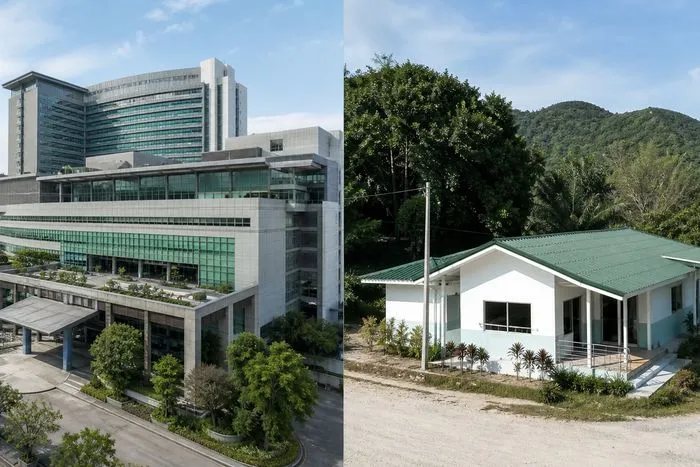
The directory contains 22 hospitals and clinics in four geographic clusters, grouped into three accreditation-confidence tiers. Location affects more than convenience. A clinic on Koh Lipe or Koh Phangan does not have the same treatment capacity or referral network as a large hospital in Bangkok or Chiang Mai.
Accreditation traced to the facility’s own dated page or an official-tier source: Bangkok Hospital Chiang Mai has a JCI Gold Seal for the 2024-2027 cycle. Bangkok Hospital Ratchasima has confirmed JCI and Thailand HA status.
Bangkok Hospital Udon Thani has Thailand HA status confirmed through a UK government listing; it is explicitly not JCI accredited but holds CAMTS certification for emergency services and ISO certification for its lab.
Bangpakok 9 International Hospital appears in the Global Healthcare Accreditation registry for November 2022-November 2025, although that window may have lapsed. These are the only four facilities in this hub whose listed accreditation can be traced beyond a marketing page or aggregator.
Facility confirmed, with accreditation absent, partial, or unresolved: Samitivej Chonburi confirms Thailand HA status on its own page, but conflicting aggregator claims leave its JCI status unresolved.
It also has the best-documented list of named direct-billing insurers in this directory. Bangkok Hospital Phitsanulok appears in the US Embassy Bangkok health-facilities list and the Bangkok Hospital Group investor directory, but no JCI or Thailand HA claim was found. Bangkok Hospital Chiang Rai appears in UK government guidance and the US Embassy list, with no accreditation claim found.
Accreditation claimed without adequate confirmation, or not claimed at all: Most facilities in the directory fall into this tier. Bangkok Hospital Samui’s detailed JCI claims trace to one commercial aggregator, with no corroboration from the hospital or JCI register. Thonburi Chumphon Hospital does not appear in its parent group’s published list of AACI-accredited facilities.
Siam International Clinic in Patong is a walk-in urgent-care clinic with no accreditation claim.
For Andaman International Clinic on Koh Lipe, research found no accreditation, insurer relationship, staff count, or years-of-operation data, even though it is one of the island’s few round-the-clock medical options.
If you are choosing between Thailand’s two main long-stay bases, Chiang Mai vs Bangkok as a long-stay base compares hospital infrastructure with living costs, visa logistics, and the depth of each city’s expat community.
Market and Legal Reality in Thailand
Thailand’s Ministry of Public Health licenses the hospital sector. Licensing is not the same as voluntary accreditation.
Bangkok Dusit Medical Services, or BDMS, is Thailand’s largest private hospital operator. It runs more than 60 hospitals under the Bangkok Hospital, Samitivej, Phyathai, Paolo, BNH, and Royal International brands. Thonburi Healthcare Group and independently owned facilities also operate in the market.
Four accreditation or certification schemes appear among the private hospitals covered here. JCI, or Joint Commission International, is a US-based international accreditor. Thailand’s Healthcare Accreditation Institute runs the domestic HA standard.
Global Healthcare Accreditation operates a public registry focused on medical travel, while the American Accreditation Commission International runs the AACI program. A facility may hold one scheme, several, or none; one status cannot be substituted for another.
A government-linked marketing page valued Thailand’s medical tourism market at 2.57 billion USD in 2023 and projected it to reach 16 billion USD by 2030, with more than 1.4 million international patients each year.
Those figures deserve caution.
A December 2025 working paper from Thammasat University’s Center of International Competitiveness and Development Studies says enthusiasm for the industry is often supported by overestimated foreign-patient flows.
It also warns of a possible “lemon market problem” as smaller providers compete more heavily on price.
How to Verify Accreditation Claims Yourself
Use this sequence before relying on any accreditation claim:
1. Search the accreditor’s directory. Do not stop at the hospital’s own website.
JCI provides a “Find Accredited Organizations” directory at jointcommission.org, and Global Healthcare Accreditation publishes an “Accredited and Certified Organizations” register. During research for this hub, JCI’s directory could not be retrieved in a usable form: it produced neither a searchable list of accredited Thai hospitals nor facility-level accreditation dates.
As a result, the JCI claims in this directory trace to hospital marketing pages or third-party aggregators rather than a usable JCI registry entry. That weakens the evidence.
2. Match the exact facility or campus. Accreditation applies to a named organization or campus, not automatically to every hospital in the same group.
If a group lists only some branches as accredited, treat the remaining branches as unconfirmed. For instance, Thonburi Chumphon Hospital does not appear in Thonburi Healthcare Group’s published list of AACI-accredited facilities.
3. Look for current dates. Accreditation cycles expire and require renewal.
JCI cycles commonly last around three years. An undated statement does not establish current status, while Bangkok Hospital Chiang Mai’s stated JCI Gold Seal cycle of 2024-2027 provides a specific period to verify.
**4.
Read the exact wording.** “Accredited” is not equivalent to “follows international standards” or “has implemented the accreditor’s standards.” The softer phrases do not confirm certificate-level accreditation.
5. Ignore status implied by a name. “International” is a marketing term, not a designation awarded by a health authority or accreditation body. It does not prove accreditation, English-language support, or an insurer relationship.
6. Treat aggregator prices as estimates. The sample prices found during this research are promotional package estimates in US dollars or Singapore dollars, not hospital price lists in Thai baht.
None of the facilities in this hub publishes a general outpatient consultation price. You will need to ask the facility directly (not ideal, but more reliable than treating a package listing as a standard fee).
Risks, Referral Pathways, and When to Evacuate
For a small hospital or clinic, accreditation may not be the most urgent question. Ask what the facility can treat on-site and where it sends patients whose needs exceed that capacity. Referral and transfer arrangements are often poorly documented.
Andaman International Clinic is one of the few round-the-clock medical options on Koh Lipe, an island with no hospital and intermittent ferry service. That does not establish the quality of its care, but it does mean that more serious cases depend on evacuation. Siam International Clinic in Patong has a different limitation: it is a walk-in urgent-care clinic, not an emergency-capable hospital.
Before planned treatment, verify the facility’s current status with the accreditor and ask both the hospital’s insurance office and your insurer about direct billing. These arrangements are plan-specific and can change. If you may need more than minor or routine care, ask the facility where it transfers patients, how the transfer works, and what happens when transport is unavailable.
In a medical emergency, call Thailand’s emergency number, 1669, or go to the nearest hospital. Do not delay care while checking this directory.
Browse the full index
Bangkok
- Bangpakok 9 International Hospital: Accreditation & Verdict - Listed in the official Global Healthcare Accreditation registry for November 2022-November 2025, though that period may have lapsed. Its JCI claim comes only from an aggregator and remains unconfirmed.
- Phyathai 3 Hospital, Bangkok: Accreditation & Verdict - This addressed branch belongs to the six-hospital Phyathai network, but no branch-specific accreditation was found. A group-wide claim does not confirm this facility’s status.
Chiang Mai & the North
- Bangkok Hospital Chiang Mai: Accreditation & Verdict - A 122-bed hospital with a JCI Gold Seal confirmed on its own dated page for the 2024-2027 cycle, giving it the strongest JCI evidence among the listed facilities outside Bangkok.
- Bangkok Hospital Phitsanulok: Accreditation & Verdict - The operator’s directory and the US Embassy list both confirm the facility. No JCI or Thailand HA accreditation claim was found.
- Bangkok Hospital Chiang Rai: Accreditation & Verdict - Three independent official or quasi-official sources confirm the facility, but even the detailed UK government table contains no accreditation entry.
Islands (Gulf & Andaman)
- Bangkok Hospital Samui: Accreditation & Verdict - The Bangkok Hospital Group’s flagship on Koh Samui and the parent of Phangan International Hospital. Its “JCI since 2012” statement and supporting details trace to one unconfirmed commercial source.
- Phangan International Hospital: Accreditation & Verdict - An official Bangkok Hospital Samui branch operating 24 hours in Baan Tai, Koh Phangan. No independent accreditation claim was found.
- Koh Chang International Hospital: Accreditation & Verdict - The only Bangkok Hospital Group branch on Koh Chang. Its JCI Ambulatory Care Standard and Thailand HA periods expired in 2011-2014, and no renewal was found.
- Bandon International Hospital: Accreditation & Verdict - An independently owned hospital founded in 1987 and Koh Samui’s first private hospital. No accreditation registry match was found.
- Thai International Hospital (Chaweng, Koh Samui): Accreditation & Verdict - A smaller outpatient and dental facility in central Chaweng that does not provide emergency care. An aggregator claims three cycles of JCI reaccreditation, but the claim could not be corroborated.
- Samui International Hospital: Accreditation & Verdict - A smaller, independently branded Koh Samui hospital near North Chaweng. No accreditation claim was found.
- Siam International Clinic, Patong: Accreditation & Verdict - A walk-in urgent-care clinic in Patong, unrelated to “Siam Clinic Phuket.” No accreditation claim of any kind was found.
- Andaman International Clinic, Koh Lipe: Accreditation & Verdict - One of the few round-the-clock medical options on remote Koh Lipe. No accreditation, insurer relationship, staff count, or years-of-operation information was found.
- International Clinic, Ko Chang: What We Found - This is probably a duplicate map record for Koh Chang International Hospital under its pre-2015 name. No separate accreditation information was found.
- Bangkok Hospital, Thong Sala (Ko Phangan): What We Found - Research could not confirm that this is a separate facility from Phangan International Hospital.
Provincial Mainland & East Coast
- Bangkok Hospital Ratchasima: Accreditation & Verdict - A 203-bed provincial hospital with JCI and Thailand HA status confirmed on its own page, giving it some of the strongest accreditation evidence in this hub.
- Bangkok Hospital Udon Thani: Accreditation & Verdict - Thailand HA status, CAMTS certification for emergency services, and ISO certification for the lab appear in a UK government listing. A BDMS investor filing also confirms the facility, which is explicitly not JCI accredited.
- Samitivej Chonburi: Accreditation & Verdict - This facility provides the directory’s clearest named list of direct-billing insurers. Its own page confirms Thailand HA status, while its JCI status remains unresolved.
- Thonburi Chumphon Hospital: Accreditation & Verdict - Chumphon province’s largest and longest-established general hospital, operating for more than 33 years. No JCI, Thailand HA, or AACI claim was found, and it is absent from Thonburi Group’s 12-facility AACI list.
- Pattaya International Hospital: Accreditation & Verdict - A community hospital listing 20 specialties, with its web presence divided across three domains. No JCI, Thailand HA, AACI, or GHA claim was found.
- Roi Et - Thonburi Hospital: Accreditation & Verdict - A 100-bed general hospital in Thonburi Healthcare Group. It appears on an AACI list shared through social media, but not in AACI’s own registry, so its accreditation remains unconfirmed.
- Mukdahan International Hospital: Accreditation & Verdict - A corroborated 60-bed provincial hospital in a Mekong border-trade town. No accreditation or international-service claim was found.
Frequently asked
Does an accreditation claim remain valid if the hospital page has no cycle dates?
Not necessarily. Accreditation is time-limited and must be renewed. Treat an undated claim as unconfirmed until you can match the exact facility to a current accreditor record or a dated certificate.
What should I ask a small island clinic before relying on it?
Ask what it can treat on-site, where it transfers patients who need hospital care, how transport is arranged, and what happens when ferries or other transport are unavailable. A round-the-clock clinic is not necessarily an emergency-capable hospital.
What is the difference between direct billing and reimbursement with my travel or health insurance?
With direct billing, the hospital sends eligible charges to a contracted insurer. With reimbursement, you pay first and submit a claim afterward. Direct billing depends on the facility, insurer, and terms of your plan, so confirm it with both parties before treatment.
How much does a doctor’s visit cost at a private Thai hospital without insurance?
Most hospitals in this directory do not publish outpatient consultation fees. Ask the facility directly.
Aggregator platforms may show package or procedure estimates, sometimes in US dollars or Singapore dollars, but those figures are not general consultation prices or official hospital price lists in Thai baht.
Can a clinic’s accreditation tell me whether it can handle an emergency?
No. Accreditation and treatment capacity are separate questions. Confirm whether the facility provides emergency care, what it can manage on-site, and which hospital receives patients who need a higher level of care.