What Travel Insurance Covers (and Doesn't) in Thailand

On this page
- Your home health insurance almost certainly stops at the border
- How much coverage to buy - and how weak the usual number is
- The five exclusion categories that decide whether you get paid
- Red flags when you are shopping a policy
- Diving, riding, Muay Thai: the activities that need a rider
- Coverage-gap question generator
- Coverage-gap checklist (print or copy this)
- Who pays the hospital first - and how much cash that means carrying
- Evacuation coverage, and why it is usually a separate line
- What I check before I buy a policy now
- Questions I get asked about insuring a Thailand trip
- What's the difference between a primary and a secondary policy, and does it matter if I'm American?
- I keep reading that insurers deny most Thailand claims - where's the catch?
- Is US$50,000 in medical cover actually enough for Thailand?
- The hospital is asking for a deposit before treating me - isn't that what my insurance is for?
- I'm booking a fun dive / a Muay Thai camp - do I have to tell the insurer?
- Does riding a scooter void my whole policy?
- Do this before you pay
- Sources
Two quotes open in two browser tabs and a departure date already paid for. That is where most people are when they start reading about this, and it is where I was in my first year in Thailand.
I bought the cheaper policy, flew, and later spent time admitted to a hospital in Chiang Mai on a policy that came close to not paying. The headline limit was fine.
What nearly sank it was a short block of exclusion text I had never opened.
This page settles two things for you: which exclusion categories to check against the trip you actually booked, and what to ask an insurer in writing before you hand over money.
It also tells you how much cash you should expect to front at the counter, which catches Americans off guard more often than the price does.
Checked as of August 11, 2026.
This page is general information about how travel insurance policies are structured, not insurance or financial advice; coverage is specific to each policy and each insurer, and the only document that decides what you are covered for is your own policy wording or product disclosure statement.
Your home health insurance almost certainly stops at the border
Start with the assumption that costs the most money, because it is the one people carry onto the plane.
US domestic health coverage, Medicare included, generally does not extend outside the country of residence, and the exceptions are narrow and specifically defined rather than broad (US Medicare, coverage outside the United States, medicare.gov).
That is the one fact on this page I will state without a hedge, because it comes from the program itself.
The part that trips up first-timers is not the price. It is the transaction. If you are used to a domestic network, you show a card, someone bills someone else, and money is a letter that arrives weeks later.
Thai facilities generally work the other way around for anything that is not an emergency: they expect a guarantee of payment from an insurer they have a contract with, or cash or a card from you, before service.
That is a pattern I have watched play out at admissions desks rather than a rule I can point at in a statute, so treat it as the common case and not a universal one.
So the practical translation of "my insurance won't work here" is not only that you need a policy. It is that you need to know, before you are standing at a counter feeling unwell, whether your policy talks to the hospital or whether you do.
How much coverage to buy - and how weak the usual number is
The safe rule first, because it survives whatever the market does to its pricing: size your limits to an inpatient stay plus an air ambulance out of the country. Treatment is rarely the catastrophic number. Getting a stabilized patient from an island or a provincial hospital to adequate care, or home, is the line item that produces a bill nobody budgets for.
Now the number you have probably already seen. One commercial 2026 destination guide recommends that a Thailand policy carry at least US$50,000 in emergency medical coverage and US$100,000 in medical evacuation.
I could not trace those figures to a named comparison service, to any insurer, or to a regulator, and no URL for that guide was captured in my research, so what you are looking at is a shopping reference point that circulated in 2026.
It is not an industry standard, it is not a Thai legal requirement, and it is not "what experts recommend."
I am not going to publish a recommended amount as if it were settled, because I do not have a source that would make that honest. What I do instead: pull two or three quotes, then compare the medical limit and the evacuation limit as separate columns across all of them.
The spread between quotes tells you more than any single published figure, and it exposes the plans that look competitive only because the evacuation line is thin.
Every figure on this page is a snapshot with a date attached. Re-check it against live quotes before you buy.
One boundary while we are on limits: if you are living here and renewing a short-trip policy year after year, trip insurance has stopped being the right product for you, and annual resident coverage is a different decision that I am not making on this page.
The five exclusion categories that decide whether you get paid
A policy does not pay what the brochure says. It pays whatever its exclusions leave standing. Five categories do nearly all of that work, and the useful skill is not memorizing them - it is knowing which ones your specific trip touches, then getting the clause quoted back to you in writing.
Here is the honesty problem sitting underneath this section, and I would rather put it in the middle of the page than in a footnote.
Real exclusion wording turned up in exactly two genuine insurer policy documents during my research, and neither is a Thailand-market product: The AA's UK backpacker travel insurance wording (dated February 2026) and Hollard's outbound travel policy from Namibia (undated).
Both make holding a valid license for the vehicle or class a condition of coverage. Two independent markets carrying the same generic condition is what makes it an industry pattern rather than one insurer's quirk. No Thailand-market insurer's own policy document or PDS was retrieved in this research pass.
So read the table below as an illustration of how these clauses are written, not as your terms. Your own policy wording is the only document that governs your case, and nothing on this page can override a line in it.
While I am killing things: you will find pages telling you the single most common reason claims get denied in Thailand, usually with a confident percentage. I found no benchmarked claims data behind any version of that claim. Every "most common" framing I traced ran back to commercial comparison sites quoting each other, so I am not repeating a denial rate here in any form.
The checkable version of that worry is narrower and lives in the four columns below.
| Exclusion category | Policy tier where it typically applies | What to ask the insurer, in writing | Source strength |
|---|---|---|---|
| Activity / "adventure sports" | Varies by policy - confirm in your own PDS | "Is [name the activity] covered under this exact plan, and can you quote me the clause that says so?" | Industry-standard pattern; no Thailand-market policy document retrieved in this research |
| Intoxication and alcohol-related injury | Varies by policy - confirm in your own PDS | "How does this policy define intoxication, and what wording applies to an injury where alcohol was involved?" | Industry-standard pattern; no Thailand-market policy document retrieved in this research |
| Pre-existing conditions | Varies by policy - confirm in your own PDS | "Which conditions count as pre-existing under this policy, and what do I have to declare before coverage starts?" | Industry-standard pattern; no Thailand-market policy document retrieved in this research |
| Vehicle-license conditions | Varies by policy - confirm in your own PDS | "What license does this policy require me to hold for the vehicle I will be riding, and where is that condition written?" Then read the license-specific exclusion that can void motorbike coverage | Real clause language in two named non-Thailand documents: The AA (UK) backpacker wording, February 2026, and Hollard (Namibia) outbound policy, undated |
| Medical evacuation tiering | Varies by policy - confirm in your own benefit schedule | "What is the evacuation limit on this plan, is it included or an add-on, and who arranges the transport?" | Directional pattern only; no named insurer's tier table was located in this research |
Red flags when you are shopping a policy
- An insurer or broker who won't put a coverage answer in writing as clause text. Ask again by email and quote the activity by name; a verbal yes is worth nothing at claim time.
- A comparison page naming the "best policy for Thailand" without ever quoting the policy document. Go find the PDS yourself and search it.
- A coverage claim repeated across many pages with no common origin document. Wide repetition is a reason to dig, not corroboration.
- A benefit stated with more confidence than its source supports. Downgrade it in your head to "unverified" until you see the clause.
- A specific number with no date and no source attached. Treat it as decoration and compare live quotes instead.
- Pressure to decide now on a limited-time price. Close the tab; the same product will be there tomorrow at a similar number.
- An evacuation benefit described without a limit figure or a named assistance provider. Ask for both in writing before you compare that plan against anything.
Diving, riding, Muay Thai: the activities that need a rider
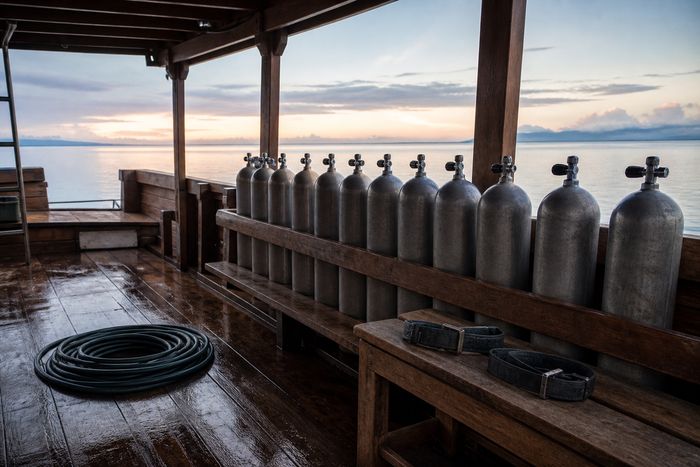
"Adventure sports" is not a defined term.
That single sentence is the whole mechanism, and it is why two policies at the same price can differ completely on whether a guided fun dive is covered: each insurer draws its own line, in its own wording, in a document you have to open.
Anyone who tells you a category of activity is "usually covered" is guessing on your behalf.
I am not going to tell you whether your dive is covered, because I cannot know that from any source I have. What I can give you is the exact clause type to ask about, per activity.
Motorbike or scooter riding. Ask for the vehicle-license condition and the engine-capacity wording, and ask which of the two the insurer applies at claim time. The license side of this is worked through in the article linked in the table above.
Recreational diving.
Ask for the sports and hazardous-activities schedule, whether certification level and depth limits appear in it, and whether a supervised introductory dive is treated differently from a certified dive.
Combat-sports training. Ask for the wording on contact sports and on training versus competition. A tourist Muay Thai class and a booked fight can sit on opposite sides of one clause.
Remote-island travel. This one is less about exclusions and more about the evacuation line: ask what the policy pays for transport from a location without adequate care, and who arranges it.
Two switches also change the shape of your answer: a trip longer than a standard short-trip policy covers, and any known pre-existing condition. Both need to be raised before purchase, not disclosed after an incident.
Coverage-gap question generator
Coverage-gap checklist (print or copy this)
- List every activity you actually plan to do, before you open a single quote.
- Search the policy document itself for that activity, not the marketing page.
- Search it for the vehicle-license wording if you will be on two wheels at all, even once.
- Find the medical limit and the evacuation limit as two separate numbers.
- Find the claim-filing window and write the date it would expire on.
- Establish whether the policy pays the facility or reimburses you afterward.
- Get any answer that matters quoted back to you as clause text, in writing.
- Check whether the policy is primary or secondary, and confirm what that means for you.
- Note the as-of date of every figure you compared.
A ticked checklist removes the failure modes you can see in advance. It does not guarantee that a claim gets paid.
Who pays the hospital first - and how much cash that means carrying
Readers merge two separate questions here, and the merge is expensive. Axis one is the relationship between your insurer and the building you walk into. Axis two is the structure of the policy itself.
On axis one: direct billing exists only where your specific insurer holds a contract with that specific facility. Bumrungrad International Hospital explains it in those terms on its own site - contracted insurers can be billed, and for everyone else the default is a deposit with reimbursement afterward.
Whether the hospital you would actually use direct-bills your insurer is a facility-by-facility question, and it is the subject of another article; go check whether your insurer direct-bills the hospital you'd use rather than assuming your card gets you through admissions.
On axis two: a primary policy is normally described as paying without your home insurer being billed first, while a secondary policy expects you to exhaust home coverage before it responds. I have that from general market material rather than from a policy document, so treat it as how the two structures are usually described and confirm which one your quote is.
For a US traveler the distinction is mostly academic anyway, for the reason at the top of this page.
| How the policy pays | How it works | Cash you may need at the counter | The catch |
|---|---|---|---|
| Direct-billing insurer | Insurer settles with the facility under an existing contract, via a guarantee of payment | Possibly little or none, though a deposit can still be requested | The contract is facility-specific, so it has to be checked hospital by hospital, not insurer-wide |
| Pay upfront, then claim reimbursement | You settle the bill yourself and submit documents afterward | Real cash or card headroom at the point of care | You carry the timing risk: per one unverified, undated source, filing windows commonly run 30 days and up to 90 with some insurers, with processing typically 2-6 weeks |
| Primary policy structure | Responds without your home insurer being billed first | Depends on the row above, not on this one | Described this way in general market material rather than confirmed in a Thailand-sold policy document; get it in writing |
| Secondary policy structure | Expects home coverage to be exhausted before it pays | Depends on the row above, not on this one | Largely moot for a US traveler, since home coverage generally does not apply abroad at all; still worth confirming which structure you bought |
Budget for the pay-then-claim case even if you expect direct billing, because that is the default you fall back to. If you want the wider picture on getting treated here, there is more on staying safe and getting medical care in Thailand in this section of the site.
Evacuation coverage, and why it is usually a separate line
The largest single bill in a bad Thailand story is almost never the treatment. It is the aircraft.
Medical evacuation coverage buys transport to a facility that can actually treat you, or repatriation home, and the part buyers miss is that it is arranged through the insurer's assistance network rather than booked by the patient or the family.
Some insurers route accident and travel claims through evacuation and assistance companies, International SOS and Mondial Assistance among the names that come up, instead of billing a hospital directly.
I have that as a description of the routing model from commercial sources, not as a coverage guarantee or a recommendation. The routing matters for one reason: a private air ambulance that a panicking relative charters directly can land outside the terms of the benefit.
Evacuation is commonly sold as a distinct, separately priced add-on rather than bundled by default into a base plan. Commonly, not always, and the sourcing there is professional rather than documentary, so verify it on the plan in front of you.
Here is what I do not have.
I could not retrieve a real named insurer's tier table showing evacuation excluded at the base tier and scaling upward through higher tiers, so I am not going to illustrate the pattern with an invented example.
Tiers do differ substantially on this line, directionally, and that is as far as the evidence goes. Open your own benefit schedule, find the evacuation entry, and read it as its own number rather than as a subheading of the medical limit. If it has no figure next to it, that is the answer to your question about that plan.
What I check before I buy a policy now
For years I told people the useful move was simply to have a policy. Any policy, buy it before you fly, tick the box. Working through actual policy documents for this article is what finally killed that advice for me.
A policy that excludes the exact thing you came here to do is not coverage, it is a receipt. The correction is not a better product, it is a habit: read the document.
My routine, in order. I write down the trip's activities before I open a single quote, because deciding what I do after seeing what is covered is how you end up rationalizing. I open the PDS and search it for the activity word and the vehicle-license wording, and I never treat the marketing page as the policy.
I send one email that forces a clause to be quoted back to me. I look at the evacuation line separately from the medical limit. I confirm the claim window before departure rather than from a hospital bed.
I rank a source by whether it has authority over the specific claim, not by how many pages repeat it. Ten sites agreeing is a reason to go find the original document, not evidence that there is one.
None of this guarantees payment. It removes the failure modes you can see in advance, which is a smaller promise and the only one available.
Questions I get asked about insuring a Thailand trip
What's the difference between a primary and a secondary policy, and does it matter if I'm American?
A primary policy is described as paying without your home insurer being billed first; a secondary one expects you to exhaust home coverage before it responds. For a US traveler the distinction is largely moot in practice, because home coverage generally does not apply abroad in the first place.
I have this from general market descriptions rather than a policy document, so ask your insurer to confirm in writing which structure your quote is.
I keep reading that insurers deny most Thailand claims - where's the catch?
There is no benchmarked claims data behind that framing, so I won't repeat it. Every "most common denial reason" version I traced runs back to single-source commercial comparison sites rather than industry claims figures. The real catch is narrower and checkable: a policy pays according to its exclusions, and those exclusions sit in a document most buyers never open.
The five categories in the exclusion table above are where to look.
Is US$50,000 in medical cover actually enough for Thailand?
That figure comes from one commercial 2026 destination guide I could not trace to a named service, so it is a reference point rather than a standard or a requirement. What usually decides whether you are adequately covered is the evacuation line rather than the medical line. Compare medical and evacuation limits across two or three quotes instead of anchoring on any single published number.
The hospital is asking for a deposit before treating me - isn't that what my insurance is for?
Direct billing only exists where your insurer holds a contract with that specific facility; otherwise the default is deposit first, reimbursement later. Per an unverified, undated source, the filing window commonly runs 30 days with processing of about 2-6 weeks, so plan for weeks of your own money being out.
Whether the hospital you'd actually use direct-bills your insurer is answered in the check whether your insurer direct-bills the hospital you'd use article.
I'm booking a fun dive / a Muay Thai camp - do I have to tell the insurer?
Ask, and ask by name. "Adventure sports" is not a defined term, so two policies at the same price can land on opposite sides of the same activity. Get the clause quoted back to you in writing before you pay, and use the question generator above to see which activities on your itinerary need raising.
Does riding a scooter void my whole policy?
Vehicle-license conditions are a real and standard exclusion category, and the specific question of licenses, endorsements and what they do to a motorbike claim is worked through in full in the license-specific exclusion that can void motorbike coverage.
Do this before you pay
Run the coverage-gap question generator against the trip you have actually booked, not the trip you might take. Then send your insurer the questions it produces, and wait for the clause text to come back in writing before you buy the policy.
Sources
- US Medicare, coverage outside the United States (medicare.gov) - official, high reliability. Supports the general rule that US domestic health coverage, Medicare included, does not extend abroad except in narrow specified circumstances. No page-level URL was captured in this research; find the coverage-outside-the-US page on medicare.gov.
- The AA (UK), backpacker travel insurance policy wording, dated February 2026 - insurer policy document, authoritative for that policy only. Real clause language making a valid license for the vehicle class a condition of coverage; shown here as an illustration of how such clauses are written.
- Hollard (Namibia), outbound travel insurance policy, undated - insurer policy document, authoritative for that policy only. The same generic valid-license condition in a second, independent market, which is what makes it an industry pattern rather than one insurer's quirk.
- Bumrungrad International Hospital, direct-billing and deposit explanation (bumrungrad.com), page undated, retrieved during this research pass - provider's own explanation. Cited for the payment mechanism only, with no price and no hospital comparison.
- The US$50,000 emergency medical / US$100,000 medical evacuation benchmark - attributed in my research to one commercial 2026 destination guide that is neither named nor linked. Commercial, 2026, not traceable to a named service. Printed as a reference point, never as a standard.
- Medical evacuation commonly sold as a separately priced add-on rather than a bundled benefit - professional source, 2025, no primary document, still requires verification.
- Claim-filing window of 30 days (up to 90 with some insurers) and 2-6 week processing - single unverified, undated, low-reliability source. Used for expectation-setting only and labeled as such wherever it appears.
No Thailand-market insurer's own policy wording was retrieved in this research pass. If that changes, it would upgrade the exclusion section from an illustrated pattern to a locally sourced fact. Re-check trigger on every figure here: 90 days.
Not insurance or financial advice. Everything above describes how travel insurance policies are generally structured; it does not tell you what you are covered for. Coverage is specific to each policy, each insurer and each traveler, and the only document that decides your case is your own policy wording or product disclosure statement. No policy, tier or rider guarantees that a claim will be paid, and nothing here should be read as a claim about how any named insurer handles Thailand claims. Every figure on this page carries a date and should be re-checked against live quotes and current policy documents before you purchase.
