Thailand Park Closures and Ferry Cancellation Risk
On this page
- Two different problems, one booking decision
- Which parks and islands close, and when
- Is it open? A three-state check
- The Andaman-side closures
- The Gulf-side closures
- How far ahead the dates are actually confirmed
- What happens if you show up during a closure
- The boat cancellation risk nobody publishes a schedule for
- Before you book: the ten-minute check
- If you are already at the pier
- Frequently asked questions
- Before you pay
- Sources
The boat to Ko Tao was canceled before 07:00, and I learned it from a sign taped to the ticket window at Chumphon pier.
No message, no email, and nothing I could have checked the night before, because there was nothing to check.
That queue at the counter taught me the split this whole page is built on: two different risks sit under an island booking, and only one of them is written down.
A national park closure is declared by a government department, dated, and enforceable.
A rough-sea boat cancellation is decided the morning of, by an operator, with no published schedule behind it anywhere.
This page gives you the reported closure windows, how firmly each one is actually documented, and where the current announcement lives.
It does not give you a guaranteed calendar, because no honest page can.
Closure dates in Thailand are redeclared every year by the authorities and confirmed shortly before the season starts. Treat everything below as a reference point and verify the current year's official announcement before you pay for transport.
Two different problems, one booking decision
A closure by the Department of National Parks, Wildlife and Plant Conservation (DNP) is a legal prohibition. There is an issuing office, an announcement relayed through government channels, a start date, an end date, and enforcement behind it. You can look it up.
It is binary: on a given day the park is either open to tourism or it is not, and the answer applies to a group tour and a private boat equally.
A boat cancellation is nothing like that. It is probabilistic, it gets decided within a day or two of departure, and no transport authority and no meteorological agency publishes an advance seasonal cancellation calendar. That absence is not me being cautious.
In the research behind this page it stands as a documented gap: the only concrete cancellation events I could pin down were ad hoc same-week notices from operators and community pages, tied to one storm system in one year.
So when a page tells you to "avoid the monsoon," notice what it has actually handed you. Not a date, not an authority, not a decision rule. The legal risk is lookup-able and the weather risk is not, and the useful move is to treat them as separate line items in the same purchase.
Which parks and islands close, and when
Thailand does not have one national closure calendar, and the parks that do close are not all closed at the same time of year. Andaman-side parks shut during the Andaman's wet season. Gulf-side sites shut during the Gulf's, which arrives later.
The closure map follows the two monsoon systems rather than a single summer, which is why "Thailand's parks close in summer" is wrong for half the coastline. If you have not settled on a coast yet, start with which coast is actually in season for your dates and come back to this table with a shortlist.
Read the confidence column as carefully as the dates column. Two of these rows rest on sources I would not book a non-refundable fare against.
Closure dates last verified: August 11, 2026. Re-check the current season's announcement yourself before booking.
| Site | Reported closure window | Source and confidence | Ticket / booking | Risk category |
|---|---|---|---|---|
| Similan and Surin Islands (Andaman) | May 16 to October 14 in 2025; reported May 15 to October 15 for 2026 | Official PRD relay of the DNP order, plus media citing the DNP regional office. High confidence on the shape of the window, day-level uncertainty at each edge | DNP e-ticket, in advance or same day before 08:00; overnight stays on the islands reported as no longer permitted | Legal closure |
| Ang Thong National Marine Park (Gulf) | November 1 to December 15 commonly reported; a single weak source says October 20 to December 20 | Medium confidence; one source cites a government announcement, and no official DNP page was reachable for this article | Entrance ticket at the park; DNP online booking for this park reported out of service, unresolved as of June 2026 | Legal closure |
| Tarutao / Mu Ko Adang-Rawi (Andaman) | "Mid-May to mid-October" or June 1 to September 30, unresolved | Low confidence; two non-official sources that may not be describing the same scoped area | Verify with the Protected Area Regional Office before you commit | Legal closure, dates unresolved |
| Mu Ko Chumphon islands and a waterfall on Ko Pha Ngan (Gulf) | Roughly November to mid-December | Low to medium confidence; the regional pattern is reported, the individual dates are not officially confirmed here | Verify with the Protected Area Regional Office | Legal closure |
| Samui / Ko Pha Ngan / Ko Tao ferry routes (Gulf) | No closure window exists | One dated disruption documented, November 19 to 22, 2025; no authority publishes a schedule | The operator's own booking and refund policy | Weather risk, not a closure |
Row five is the point of the table: it looks different from the rows above it because it is a different kind of risk, and no amount of research will turn it into a date range.
Is it open? A three-state check
Run your site and your date through this before you buy anything. It returns one of three answers, and two of them are not "no."
- Pick the site from the five entries in the table above. Ferry routes are deliberately not checkable here, because there is no dataset behind them and pretending otherwise would be the exact mistake this page exists to prevent.
- Likely closed: your date falls inside a high-confidence window, more than about two weeks from either edge. Similan or Surin in late June is this case.
- Likely open: your date sits well outside the reported window for a high-confidence entry. Similan in February, Ang Thong in March.
- Verify closer to your date: everything else. Any date within roughly two weeks of a window boundary, because that is the interval in which DNP confirms. Every low-confidence or unresolved entry regardless of the date, which means Tarutao and Mu Ko Adang-Rawi, the Mu Ko Chumphon islands and the Ko Pha Ngan waterfall always land here.
Whatever it returns, the answer is "likely," it comes from a stated year's dates, and the window is redeclared annually.
The Andaman-side closures
Similan and Surin are the anchor case because they are the best-documented.
For 2025, the closure ran May 16 to October 14, as relayed by the Government Public Relations Department from the DNP order.
For 2026, the season was reported as May 15 to October 15 by The Nation Thailand, citing DNP Protected Area Regional Office 5.
Look at those two edges. Mid-May to mid-October is a stable shape you can plan a trip around. The exact day is not stable, and the sources disagree by one day at both ends, most likely on dating convention rather than on policy.
That single day matters if you booked a liveaboard for the reopening.
Tarutao and Mu Ko Adang-Rawi are the honest mess. One reference site gives "mid-May to mid-October," a dive-operator blog gives June 1 to September 30, and the two may be describing differently-scoped areas within the same park complex. I am not picking a winner between them.
If Tarutao is on your itinerary, the regional office is the only source worth trusting.
The Gulf-side closures
Ang Thong National Marine Park closes later, in step with the Gulf's own wet season. The window I would plan around is November 1 to December 15, which comes from a source citing a government announcement. A single weaker claim, traced to a Facebook post, extends it to October 20 through December 20.
I am presenting the first as primary and the second as uncorroborated for a plain reason: one names an announcement, the other names nobody.
The smaller Gulf cluster follows the same rhythm. The Mu Ko Chumphon islands and a waterfall on Ko Pha Ngan are reported closed roughly November to mid-December, with the pattern better attested than any individual date.
One practical wrinkle, and it is not a closure: DNP's online booking for Ang Thong has reportedly been out of service for a prolonged period, still unresolved as of June 2026, according to a single non-government source.
If your plan depends on booking online, plan for the possibility that you cannot.
How far ahead the dates are actually confirmed
Here is the mechanic almost every competing page leaves out. DNP typically confirms the exact start and end only about one to two weeks before it happens, per the PRD relay above.
Everything earlier than that is a reference point. "Mid-May to mid-October" is a planning shape, not a bookable guarantee, and no operator can give you next year's exact date because the authority has not issued it yet.
The system is built for annual redeclaration.
According to the Tourism Authority of Thailand Newsroom, Thailand has 156 national parks and 91 forest parks, not all of which have a seasonal closure at all, and open, closed or partially open status is published per Protected Area Regional Office and relayed onward through PRD and the TAT newsroom.
The regional office is the level that issues; the two national channels are where you read it.
At least one source acknowledges that a closure could in principle begin earlier in a bad-weather year. I have not seen that expressed as a published rule with defined triggers, so treat it as an uncertainty in your planning rather than as a thing that is going to happen to you.
I used to hand friends last season's Similan dates and call it close enough. That was bad advice and I gave it for years. The redeclaration model and the one-day drift at each edge are exactly why: "close enough" is fine in March and worthless if you booked the reopening week.
What happens if you show up during a closure
Entering a DNP-closed park inside its declared window is prohibited.
That applies to a group tour and to a private or chartered boat identically, and enforcement can turn boats and visitors back at the park, per the DNP order as relayed by PRD and the TAT annual schedule.
There is no permit that buys you in, no fee that fixes it, and no version of this where a captain's confidence changes the legal status of the water.
Operators running unauthorized trips into a closed park are reported to face fines and loss of license.
I am not going to give you a number, because no published figure appeared in any source I reviewed for this page, and inventing one would make this page exactly as useful as the blogs I am warning you about.
If the amount matters to you, DNP is the authority to ask.
Which brings me to the rationalization I hear most. Someone is willing to sell the trip, therefore the park must be open, therefore it must be fine. No. A seller's willingness is evidence about the seller, and the license risk in that transaction is theirs while the wasted day and the turned-back boat are yours.
The boat cancellation risk nobody publishes a schedule for
Start with why the Gulf shoulder is the sharp end.
The Thai Meteorological Department's climate document puts the Gulf coast down as the national exception to the August and September wet peak: rain there peaks in November and stays elevated into January.
Sea state follows rain. So the late-monsoon window that looks like a bargain on a Gulf-side itinerary is the window in which departures get pulled.
One case is properly dated.
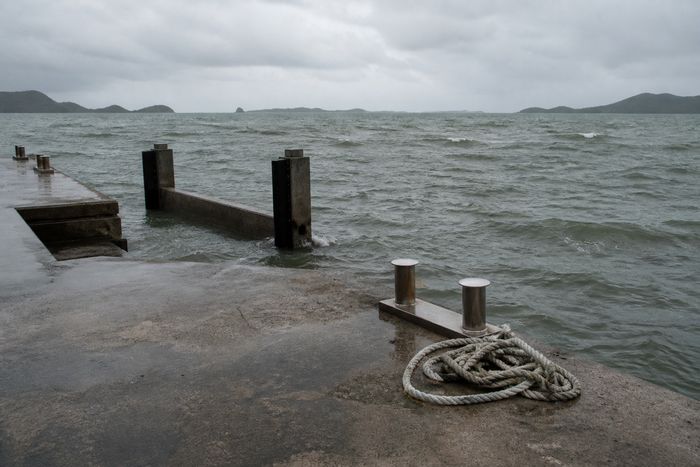
Samui and Ko Tao ferry services were halted from November 19 to 22, 2025, as rough seas disrupted travel for hundreds of travelers, reported by Pattaya Mail and relayed in real time by the Koh Tao FYI community page.
Now the part that matters more than the dates: that was a storm-tied incident in one specific year. It is not a recurring scheduled outage, and if I presented those four days as an annual pattern I would be handing you a calendar that does not exist. No authority publishes one.
Not the transport regulators, not the meteorological department, nobody.
Refunds, in the cases I researched, run directly through the individual operator rather than through any formal passenger-protection scheme. That is a description of what the research found, not a statement about Thai consumer law, which this page does not cover.
It also matches my morning at Chumphon: whatever was going to happen about money was going to happen at that counter, with that company, and my leverage was the policy I had agreed to before I paid.
Red flags on any page or pitch that gives you closure dates
- A fixed multi-year closure calendar presented as permanent. The dates are redeclared annually, so a page that projects them forward is guessing.
- A specific closure date with no issuing authority named and no year stated. Two missing pieces of metadata, one useless date.
- An operator willing to run a trip into a park inside its declared closure.
- Two different numbers for the same window on the same page, with no explanation of the discrepancy.
- A "typical November cancellation schedule" for ferries. No such schedule is published by anyone, so somebody made it up.
- A closure date whose only trace is a social-media post. Community pages are genuinely good for same-week disruption news and useless as a booking basis.
Before you book: the ten-minute check
The sequence is short. Confirm the current season's announcement for every specific protected site on your itinerary rather than the famous one you have heard of. Check whether any of those sites sits on the unresolved-dates list in the table.
For boat legs falling inside their coast's own shoulder window, price the refundable fare against the non-refundable one and look at the actual gap in baht instead of assuming it is unaffordable. Read the operator's cancellation policy before paying.
If you need the month-level signal for your dates rather than the closure question, look up your exact month in the region climate grid.
Pre-booking checklist
- List every specific park or protected site on the itinerary, not just the headline one.
- Find the current season's announcement for each, through PRD or the TAT newsroom, not a blog.
- If only a prior season's dates exist, treat them as approximate and re-check inside the one-to-two-week confirmation window.
- Check whether the site is one of the unresolved-dates cases in the table above.
- Identify every boat leg that falls inside its coast's own wet or shoulder window.
- Compare the refundable and non-refundable fare for those legs specifically, not for the whole trip.
- Read and save the operator's cancellation and refund policy before paying, in a form you can show them later.
- Check whether your travel insurance covers weather-linked cancellation, and buy the buffer day if a same-day onward flight is involved.
That last one is the cheapest insurance on the list. A buffer night in Surat Thani or Chumphon costs a fraction of a rebooked international ticket.
If you are already at the pier
The boat is canceled and it is 07:00. Your counterparty for both the rebooking and the money is the operator you bought from, so do not leave that counter without the cancellation confirmed in writing or in a message you can screenshot. Verbal reassurance evaporates by the afternoon.
Assume the next departure that does run fills instantly, and assume a same-day onward flight is the thing you are about to lose, because it is.
If what you have hit is a park closure rather than a canceled boat, there is no override to negotiate. Enforcement can turn you back regardless of what you paid. An operator offering a "similar" island instead is selling you a different product, and you are entitled to treat it as one.
Keep the entrance ticket separate in your head from the boat booking, because they are separate transactions with separate refund paths.
Reported fees, and I would verify these against the current DNP schedule rather than budget on my say-so, run around 500 baht for a foreign adult at Similan with 250 baht for a child aged 3 to 14, against 100 and 50 baht for Thai nationals; Ang Thong is reported at roughly 300 baht for a foreign adult and 150 for a child, with 40 and 20 baht for Thai nationals.
Park visiting hours are commonly reported as 08:00 to 16:00 or 08:00 to 17:00 depending on the park, which is worth knowing if your boat is late.
Frequently asked questions
Is it actually illegal to go into a Thai marine park during its closed season? Yes. The DNP order prohibits tourism activity in the park during the declared window, for group tours and private boats alike, and visitors can be turned back. Operators are reported to face fines and license loss, though no published figure was located.
DNP is the authority to ask.
How do I find the closure dates for the year I'm actually traveling? Go to the current season's announcement, not a summary. Dates are redeclared annually and confirmed only about one to two weeks ahead, issued at Protected Area Regional Office level and relayed through PRD and the TAT newsroom. A prior season's dates are an approximation, nothing more.
Is the boat to Ko Tao safe in November and December? Separate safety from reliability. Services get halted when seas are rough, which is operators behaving correctly, so your exposure is a canceled departure rather than a dangerous crossing. Gulf rain and sea state peak in November, and no published schedule predicts which days go.
If my boat is canceled, who gives me my money back? The individual operator, in the cases I researched, rather than any formal passenger-protection scheme. Get the cancellation confirmed in writing before you leave the counter, and read the refund policy before paying instead of after. That is what the research found, not a statement of Thai consumer law.
Should I book refundable transport for a November trip? For Gulf-side boat legs inside the shoulder window, yes if the price gap is modest, and I would pay a larger gap when a same-day onward flight rides on that boat. Price both fares for those legs specifically and make the call with the numbers in front of you.
Before you pay
Pull up the current official closure announcement for your own dates, through PRD or the TAT newsroom, and check it against every protected site on your itinerary. For any Gulf-side boat leg in the shoulder window, price the refundable fare before you buy the non-refundable one. Closure dates last verified for this page: August 11, 2026, and they are redeclared every year, so the re-check is yours to do.
More on picking your window: back to When to Go.
Sources
- Government Public Relations Department (PRD), relaying the DNP closure order for Mu Ko Similan and Mu Ko Surin, as of May 14 to 15, 2025. Supports the 2025 closure window and the one-to-two-week confirmation lead time.
- The Nation Thailand, citing DNP Protected Area Regional Office 5, 2026 season announcement. Supports the reported 2026 Similan and Surin window.
- Tourism Authority of Thailand Newsroom, annual seasonal opening and closure of attractions in Thailand's national park system, January 15, 2026. Supports the 156 national parks and 91 forest parks figure, per-regional-office publication, and the annual redeclaration model.
- Thai Meteorological Department climate document, retrieval date not stated. Supports the Gulf coast's November rainfall peak as the mechanism behind the shoulder-season boat risk.
- Pattaya Mail, "Samui-Tao ferry services halted as rough seas disrupt travel for hundreds," November 19 to 22, 2025. Supports the single dated cancellation event, explicitly as a one-off.
- Department of National Parks, Wildlife and Plant Conservation (DNP), the issuing authority for closure orders and the body to contact about enforcement and penalties, reached through the PRD and TAT channels above.
Thai national park closure dates are redeclared every year by the authorities and are typically confirmed only about one to two weeks before a season starts or ends, so nothing on this page is a guaranteed calendar: verify the current year's official announcement before booking, treat every window marked as low confidence or unresolved as a question for the Protected Area Regional Office, and note that no transport or meteorological authority publishes an advance ferry cancellation schedule, which is why the weather risk here is described as an undocumented gap rather than a predictable event. Entrance fees, ticketing rules and park hours are reported figures, not official quotes. This is trip-planning information, not legal advice.
