Mae Hong Son: Getting There, When to Go, Worth It?
On this page
- Quick take: is Mae Hong Son worth the stop?
- What Mae Hong Son is actually known for
- Who it actually suits
- Getting there
- When to go - and the air-quality question
- What it costs
- The honest verdict
- FAQ
- What is Mae Hong Son actually known for, compared to Chiang Mai or Pai?
- How do I actually get to Mae Hong Son, and how long does it take?
- Is Mae Hong Son worth the trip, and who is it actually right for?
- Is the air quality really as bad as some posts online claim?
- How many days should I spend in Mae Hong Son?
- Is there a best time to visit, or a season to avoid?
Quick take: is Mae Hong Son worth the stop?
Mae Hong Son is a remote provincial town in northern Thailand, reached most commonly as part of the Mae Hong Son Loop. My short verdict: it has a slower, more distinct identity than Chiang Mai or Pai, but the detour only pays off when your itinerary has enough room for the journey itself.
Mae Hong Son quick facts
- Region: Northern Thailand
- Main gateway: Chiang Mai for both road planning and checking current air connections
- Loop position: After Pai on the documented Chiang Mai - Pai - Mae Hong Son route
- Season warning: Northern burning season generally falls between January or February and April, with March often cited as the peak
If you are still assembling the wider trip, go back to all Thailand destinations.
What Mae Hong Son is actually known for
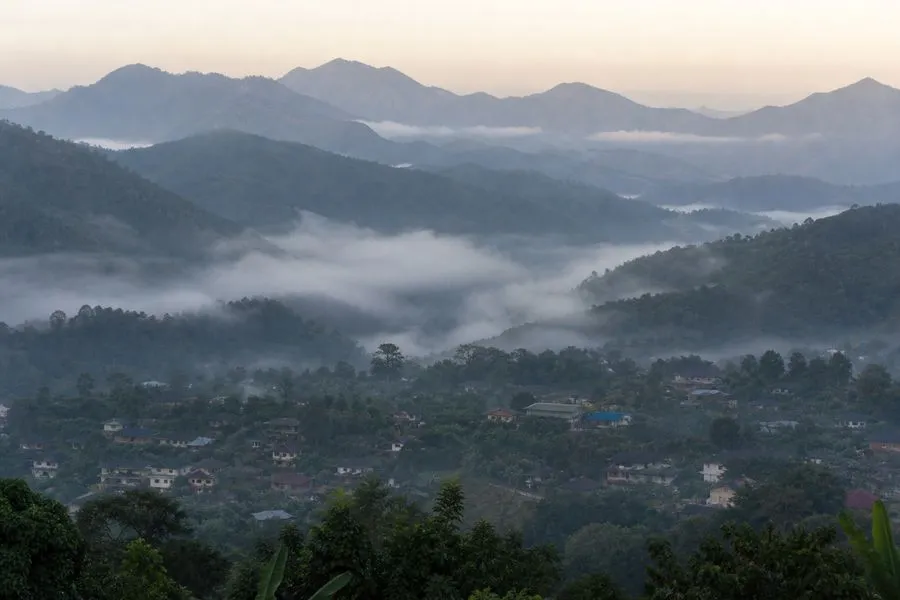
Mae Hong Son is known for being mountainous, remote, and slower-paced. That description sounds generic until you compare the town with the rest of the usual northern route. Chiang Mai functions as the developed regional hub, while Pai is already a well-known stop reached relatively early on the loop.
Mae Hong Son sits farther out and asks more of your schedule.
The difference is not a promised list of attractions. It is the town's pace and infrastructure profile. Among the major northern hub towns considered here, Mae Hong Son is the most remote and least developed.
That makes it more than another northern hill town, but it also means you should not add it casually because it appears near Pai on a map.
I would choose it for the change of rhythm. If the appeal of northern Thailand for you is partly the distance from major urban infrastructure, Mae Hong Son pushes that idea further than its better-known neighbors.
For fuller destination comparisons, compare it with Chiang Mai, compare it with Pai, the first stop on the loop, or see also: Chiang Rai, another northern hub affected by the same broad smoke-season risk.
Who it actually suits
I did not find reliable traveler-profile data specific to Mae Hong Son, so I would not pretend there is a documented type of visitor who predictably loves it. The useful decision comes from the trade-off: you get a genuinely slower, more remote stop, and you pay for it with a long approach and days that cannot be spent elsewhere.
Mae Hong Son probably suits you if:
- You prefer fewer, slower stops instead of collecting several northern towns.
- You do not mind spending substantial time on a winding road journey.
- Your northern Thailand schedule is long enough that the loop does not consume most of it.
- You are traveling outside the January-to-April smoke-risk period, or you will check live air readings before committing.
It is a poor fit if you are trying to squeeze one more Chiang Mai-adjacent destination into a tight itinerary. Mae Hong Son is not meaningfully adjacent once the road time and loop position enter the calculation.
Getting there
The documented overland path is the Mae Hong Son Loop: Chiang Mai to Pai, onward to Mae Hong Son, then back toward Chiang Mai. The complete loop is commonly cited as roughly 600 kilometers, or about 373 miles, with more than 1,800 curves. Those figures appear across commercial travel sources rather than a verified primary transport record, so treat them as planning approximations, not surveyed measurements.
The Chiang Mai-to-Pai first leg is similarly described as having 762 curves and taking about 3 hours by minibus or car. Actual road time can vary, and I would not build a same-day connection around the approximate duration (winding-road optimism has cost me enough afternoons in Thailand).
Flying is the other realistic option to investigate, but regional airport service changes too often for a fixed airline or timetable here to be responsible. Check current availability directly from Chiang Mai when booking. This research did not independently confirm a Mae Hong Son schedule, exact flight time, bus operator, or route-suspension status.
| Destination | Development/pace | Distance/position on the loop from Chiang Mai | Best for |
|---|---|---|---|
| Chiang Mai | Regional hub and most developed of the three | Gateway and loop starting point | Travelers who need the broadest infrastructure base |
| Pai | More developed than Mae Hong Son | First stop; commonly cited as 762 curves and about 3 hours from Chiang Mai | Travelers wanting a shorter extension from Chiang Mai |
| Mae Hong Son | Most remote and least developed of the three | Farther around a loop commonly cited at about 600 km with 1,800+ curves | Slower itineraries that can absorb the full detour |
The road distances, curve counts, and driving time are commonly repeated planning figures from commercial travel sources. They were not independently verified for this article.
For the wider transport framework, see more on moving between Thai cities and islands.
When to go - and the air-quality question
Northern Thailand's burning season is generally reported as running from roughly January or February through April, with March often identified as the peak. Sources disagree about the exact starting point. Mae Hong Son belongs inside that regional risk pattern, so I would plan around the window rather than a supposedly precise first day.
I also would not repeat the viral air-quality claim attached to Mae Hong Son as fact. One unsourced social-media post gave an "AQI 1357" figure while separately reporting 196 micrograms per cubic meter of PM2.5. Those values do not reconcile cleanly, and the post does not provide enough sourcing to establish either as a reliable reading for the town.
That does not make the underlying smoke problem imaginary. I spend long stretches in Krabi and on Ko Lanta during the northern smoke season because I prefer not to gamble weeks of my year on the air. The sensible rule is: do not trust the scary historical number, but do not ignore the season either.
Check a live monitor such as IQAir or Thailand's Pollution Control Department shortly before booking and again while traveling. You can also see the full year for Mae Hong Son in the Season Matrix and read the full north/south seasonal split without relying on one old screenshot.
Sources for road and seasonal claims
- inbetweentravels.com, Mae Hong Son Loop distance and curve estimates, research pass 2026.
- chiangmaigotours.com, Chiang Mai - Pai road estimates and Chiang Mai gateway context.
- global-gallivanting.com, corroborating commercial account of the loop estimates.
- Chiang Mai clinic page citing a 2023 peer-reviewed haze review, used for the approximate northern burning-season window.
- IQAir and Thailand's Pollution Control Department, recommended for live readings rather than historical claims.
Last reviewed: August 12, 2026.
What it costs
I did not find reliable Mae Hong Son-specific price data in this research pass. That means I cannot responsibly label the town cheap, expensive, or even cheaper than Chiang Mai or Pai.
Accommodation, transport, and meal figures would need current local sourcing before I attached numbers to them. I would budget the route only after checking real prices for your dates, especially because your choice between a long road itinerary and whatever flights are operating can change the overall cost. Guessing a daily tier here would create false precision.
The honest verdict
Mae Hong Son is a real destination with a distinct remote, slow-paced identity. It is not merely Pai with a longer drive. The limited development and distance are part of the reason to go, not logistical defects that can be edited out of the trip.
I think it is worth the detour when you want fewer stops, have enough days to let the road journey breathe, and accept that reaching the town is part of the commitment. It is not worth it when you are already compressing Chiang Mai and Pai into a short northern leg.
The smoke-season risk also belongs in the decision, but the viral figures do not. I encountered two incompatible measurements in the same post and refused to turn either into a neat statistic. My own choice is simpler: I time northern travel around the broader seasonal pattern and check current monitoring before I go.
FAQ
What is Mae Hong Son actually known for, compared to Chiang Mai or Pai?
Mae Hong Son is known for a remote, mountainous setting and a slower pace. It is the least developed of these three major northern hub towns, giving it a different infrastructure profile rather than merely a quieter version of Pai.
How do I actually get to Mae Hong Son, and how long does it take?
The documented overland route follows the Mae Hong Son Loop from Chiang Mai through Pai to Mae Hong Son. Flight availability and exact schedules were not independently confirmed, so check current Chiang Mai connections directly rather than relying on an old airline timetable.
Is Mae Hong Son worth the trip, and who is it actually right for?
Yes, if you want a genuinely slower, more remote stop and have enough time for the approach. It is not a sensible quick add-on when your Chiang Mai and Pai itinerary is already tight.
Is the air quality really as bad as some posts online claim?
The specific viral figures found for Mae Hong Son are not reliable enough to use. Burning season still affects northern Thailand, generally from January or February through April, so check IQAir or Thailand's Pollution Control Department for live conditions.
How many days should I spend in Mae Hong Son?
There is no verified day-count recommendation in the research used here. Allow enough time that traveling around the loop does not become the whole visit; if you cannot do that, I would leave Mae Hong Son for another trip.
Is there a best time to visit, or a season to avoid?
Avoid roughly January or February through April if smoke exposure is a concern, with March often cited as the peak-risk month. Check the Season Matrix and live air readings because the exact start and conditions vary.
If Mae Hong Son earns the detour, use the Season Matrix for Mae Hong Son as your next planning step and check current-year timing before committing to the road or a flight.
