Chinatown: Where to Stay Guide (Bangkok)
On this page
- Who Chinatown Suits
- Chinatown vs Yaowarat and Khao San Road
- Getting To and Around Chinatown
- Before You Book in Chinatown: A 4-Point Check
- Price and Lodging Tier
- Safety and Noise Notes
- The Honest Verdict
- Frequently Asked Questions
- What is the nearest MRT station to Chinatown?
- Is Chinatown a good alternative to Khao San Road?
- What kind of hotels are available in Chinatown?
- Is Chinatown walkable and safe at night?
- Is Chinatown the same as Yaowarat?
- Related Bangkok Districts and Guides
- Sources
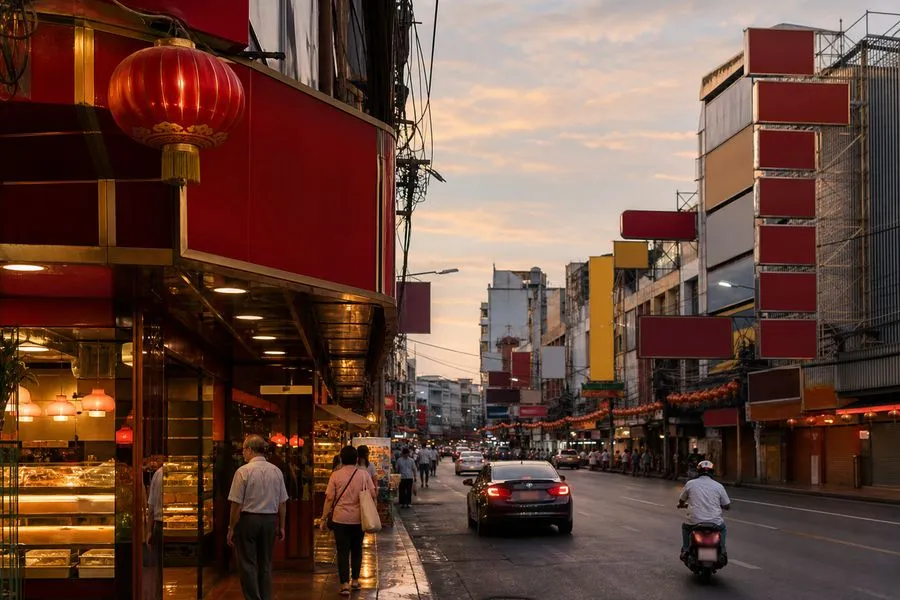
Bangkok's Chinatown is a dense, 200-plus-year Teochew-Chinese heritage district centered on Yaowarat Road and widely cited as the city's leading street-food area.
This page helps you decide whether to book here; see all Bangkok areas for district choices, or use the Bangkok travel guide for city-wide planning.
Who Chinatown Suits
Chinatown suits travelers who treat food and Chinese-heritage architecture as reasons to choose a base, rather than attractions to visit for an afternoon. Its dense street grid also gives it moderate-to-high family appeal for people comfortable navigating busy sidewalks and market crowds.
The area's evening character is driven more by food stalls and market activity than by a concentrated bar scene. That distinction matters. Chinatown is not the obvious choice for digital nomads seeking a low-density neighborhood built around long workdays, and it is not the classic backpacker party base.
If quiet surroundings take priority, look toward Riverside. Travelers who want the familiar backpacker-strip experience should compare Chinatown with Khao San Road instead. Chinatown works best when staying near the food and heritage activity is the point of the booking, not an inconvenience tolerated for a cheaper room.
Chinatown vs Yaowarat and Khao San Road
Chinatown and Yaowarat are not competing districts. Chinatown is the wider heritage and accommodation area, while Yaowarat Road is its commercial spine. The separate Yaowarat vs Chinatown page covers that narrower street-level identity without pretending the two occupy different parts of Bangkok.
Khao San Road is a different proposition: a short, roughly 400-450-meter backpacker strip within Banglamphu. Use the table to decide which framing matches the trip you are actually planning, then compare with Khao San Road if party access is central to the choice.
| District | Character | Nightlife/Noise | Best For |
|---|---|---|---|
| Chinatown | Dense heritage and food district with Yaowarat Road as its spine | Low-to-moderate; market energy rather than a bar strip | Travelers choosing food and heritage as reasons to stay |
| Yaowarat | Chinatown's commercial spine road, with a concentrated food-and-gold-trade identity | Similar to Chinatown, but more concentrated | Travelers focused specifically on the main commercial street |
| Khao San Road | Roughly 400-450-meter backpacker strip within Banglamphu | High; classic all-night party-strip character | Budget and solo travelers who want a party base |
Getting To and Around Chinatown
Sources disagree on which MRT Blue Line station should be called Chinatown's nearest: Wat Mangkon or Hua Lamphong. I will not pick one merely because a single answer looks tidier. Check the walking route from your specific hotel to both stations before paying for a nonrefundable room.
Once you arrive, Chinatown's dense street grid is best explored on foot. Bangkok's wider BTS and MRT networks influence where lodging feels convenient across the city, but ticketing and line-by-line planning belong in the getting around Bangkok guide.
Before You Book in Chinatown: A 4-Point Check
- Check both MRT candidates. Confirm the mapped walking distance from the hotel to Wat Mangkon and Hua Lamphong. Do not rely on a listing that simply says "near the MRT."
- Ask which way the room faces. A room directly over Yaowarat Road may receive more market noise than one facing a side soi or a lane toward Talad Noi.
- Recheck the nightly rate. Chinatown's lodging tier runs from budget to boutique, but a displayed rate is only a snapshot for particular dates.
- Test your tolerance for density. If crowds and compact streets sound tiring, compare with Riverside before deciding.
Price and Lodging Tier
Chinatown's reported lodging range runs from budget properties to boutique hotels, with restored Sino-Portuguese shophouses providing one of its recognizable accommodation styles. Named examples in the research include ASAI, Shanghai Mansion, and W22, but these indicate property categories rather than a dependable nightly price.
Treat that range as a planning signal, not a live rate survey. Prices and listings need to be checked again for your actual dates close to booking. For country-level context, see how Bangkok's costs compare rather than trying to infer a Thailand budget from one neighborhood's hotel inventory.
Safety and Noise Notes
At street level, Chinatown can feel crowded and hot, particularly around peak market hours on Yaowarat Road. Its nightlife has been characterized as low-to-moderate, centered on food and market energy rather than bars, but district reputations change with tourism patterns and enforcement. Recheck recent conditions instead of treating that label as permanent.
Noise varies block by block. A Yaowarat-facing room and a room on a side soi can produce very different nights (the hotel pin alone will not tell you which one you booked). Use the room-facing check in the booking list, not just the property's neighborhood description.
The Honest Verdict
Chinatown has a real point of difference: heritage, street food, and dense access to central Bangkok in one compact lodging area. It does not need inflated claims about suiting every traveler.
The unresolved MRT question is the one material gap. My rule for administrative and travel logistics is simple: when two plausible sources disagree, plan around the uncertainty instead of hiding it. Here, that means measuring the hotel-to-station walk twice, once for Wat Mangkon and once for Hua Lamphong.
If the location still works, Chinatown is a strong choice for a food-and-heritage-focused stay. If it does not, book elsewhere without trying to argue with the map.
Frequently Asked Questions
What is the nearest MRT station to Chinatown?
Sources disagree between Wat Mangkon and Hua Lamphong. Check the walking route from your specific hotel to both stations, since the practical answer depends on the property's exact location.
Is Chinatown a good alternative to Khao San Road?
Yes, if you prefer food and heritage to Khao San Road's party-strip character. Chinatown's nighttime atmosphere is generally described as calmer, though you should still verify the hotel's walk to both MRT candidates before booking.
What kind of hotels are available in Chinatown?
The reported range is budget-to-boutique, including restored Sino-Portuguese shophouse hotels. That tier is not a fixed price promise, so recheck current inventory and rates for your dates.
Is Chinatown walkable and safe at night?
Chinatown has a dense, walkable street grid and a nighttime character associated more with markets and food than with a bar strip. That is a time-sensitive area description, not a safety guarantee, so check current conditions and consider whether a room faces busy Yaowarat Road.
Is Chinatown the same as Yaowarat?
Yaowarat Road is Chinatown's commercial spine, not a separate district. Chinatown is the wider heritage and accommodation framing, while Yaowarat refers more specifically to the food-and-gold-trade street itself.
Related Bangkok Districts and Guides
Before booking, check the hotel's walk to both Wat Mangkon and Hua Lamphong.
If Chinatown feels too dense, compare with Riverside for a calmer setting or compare with Khao San Road for a backpacker party base; the Bangkok travel guide and see all Bangkok areas pages cover the wider choice.
Sources
- Wikipedia, "BTS Skytrain" article: Bangkok rail-transit context, including the BTS and MRT network.
- Travelfish: independent Southeast Asia travel-guide context for Bangkok transit and district planning.
This article provides general orientation for choosing a lodging area, not official safety or legal guidance. Distances and access conditions are approximate and may vary by source, season, and traffic. Nightlife level, crowd type, and price tier reflect the sources reviewed rather than a live, continuously verified status.
