Thailand Daily Budget: What a Day Really Costs (2026)
On this page
- The short answer: three tiers, three ranges
- How I define backpacker, mid-range and comfortable
- Line by line: where a day's money actually goes
- The one line item that moves your total most
- What a "daily budget" figure quietly leaves out
- Build your own number: the daily budget calculator
- Before you trust any of these figures, re-check these four things
- Frequently asked questions about a Thailand daily budget
- Get your own range
- Sources
You are trying to answer two questions at once: how much per day, and how many days. The second one you already know.
The first one has no honest single answer, which is why you have probably read four different figures by now and none of them agreed.
Backpacker estimates alone run from about $25 to about $56 a day as of 2026, depending entirely on who was counting and what they counted. That spread is not sloppiness on anyone's part.
It is what happens when nobody uses the same definition of "backpacker."
So this page does not hand you a number.
It gives you three tiers defined precisely enough that you can re-map any other site's figure onto them, a line-item view of where a day's money actually goes, a calculator that asks for your own quotes instead of inventing a split, and a blunt list of what these figures never include.
I have budgeted all three tiers wrong at least once, and the mistakes are in here too.
The daily ranges on this page are indicative, not a converged consensus. Nearly every cost figure here traces to travel media, tour operators or crowdsourced data rather than to government or bank statistics; no official Thai source publishes a daily-budget figure. All bands exclude international and internal flights, courses and multi-day activity fees, rental deposits and gear purchases, so no total on this page should be read as all-inclusive.
The short answer: three tiers, three ranges
| Travel style | Approximate daily spend (USD) | What that band is built from | Source | As of |
|---|---|---|---|---|
| Backpacker / budget | roughly $25-56 | Individual published estimates including $26, $28-46, $33-56, $35-40, $37 and $40; the low end assumes dorm beds, street food and shared transport | visitthailandtoday.com, Thailand Travel Costs (2026 Edition); neverendingfootsteps.com; royalthailandtours.com | April 2026 (visitthailandtoday); 2026 (royalthailandtours); neverendingfootsteps publishes no methodology date |
| Mid-range | roughly $50-167, with a widely cited "average traveler" figure of about $64/day (widely cited, not authoritative) | Private rooms, a mix of street and restaurant meals, some paid activities; the top of the band assumes daily paid activities | travelcostcalculator.org; royalthailandtours.com | 2026 |
| Comfortable | roughly $150-1,100+; most sources cluster at $150-400, with one outlier source at $420-1,100+ | Hotel-level lodging and private transport; the outlier band reflects a luxury definition, not a comfortable one | southeastasiasimplified.com, Thailand Travel Cost Breakdown 2026 | 2026 |
Every figure in that table is a source figure in USD.
None of them is a settled number, and I have deliberately not printed a baht conversion of any band, because every exchange-rate figure I could find in the source material is an undated snapshot and a rate printed on a travel page is wrong by the time you read it.
Convert at a same-day rate when you actually plan, not off a number someone typed in April.
Notice the overlap. Fifty dollars a day sits inside the backpacker band and inside the mid-range band simultaneously. That is not a rounding artifact; it is the whole problem this page exists to solve.
How I define backpacker, mid-range and comfortable
The reason the published figures disagree is methodological, and it is simpler than it looks: the sources use no standardized tier definition. One site's "backpacker" is a dorm bed and two street meals. Another site's "backpacker" is a fan room with a private bathroom and a restaurant dinner.
Both publish a daily figure under the same word, and the figures land $20 apart. That is my reading of the sources listed in the box at the end of this article, and it is the single most useful thing to know before you trust any cost page, including this one.
Here is the definition every figure below uses.
Backpacker is a spending pattern: shared or dorm accommodation, food bought at street level and at markets, public or shared local transport, and paid activities kept to a minimum or skipped. It is not an age and it is not a trip length. I have shared a dorm with a 61-year-old on a six-day holiday and paid comfortable-tier rates on a ten-week stretch, in the same year.
The word describes what you buy, nothing else.
Mid-range moves accommodation to a private room, usually with air conditioning, and adds paid activities as a normal part of the day rather than an occasional splurge. Food goes mixed: street breakfast, sit-down dinner.
Comfortable puts you in hotel-grade lodging with private or arranged transport, and this is where the tier stops behaving like a band at all. There is no ceiling. The $150-400 cluster describes people spending deliberately; the outlier band above $420 describes people for whom the daily figure is not a constraint.
Once lodging is a choice rather than a budget line, no published range predicts anything.
Where you are also changes the answer, and this page does not cover that - if you want the geography, see how the same day costs more on the islands than in the north.
One more boundary: everything here is a day rate for traveling. The per-month cost of actually living somewhere, with rent and deposits and utilities, is a different calculation entirely and belongs to the long-stay material, not to this page.
Line by line: where a day's money actually goes
| Line item | Backpacker | Mid-range | Comfortable | Where your own number comes from |
|---|---|---|---|---|
| Accommodation | Dorm bed or shared room; fan over air conditioning; booked short, often a night or two ahead | Private room, air conditioning, private bathroom; the item where the tier separation is actually visible | Hotel-grade room; no practical upper bound, so the band stops predicting | The booking site you will actually use, at the room type your tier implies, for your real dates |
| Food | Street carts, markets and convenience stores; cash-preferred at the cart, and convenience stores act as a predictable price floor when nothing else is open | Mixed: street or market by day, sit-down restaurant by evening; cards work at the larger places | Restaurant-led, hotel breakfasts included or not depending on the booking | A menu photo from a place you have actually looked up, or a per-meal figure you set yourself |
| Local transport | Shared and public: Chiang Mai's red songthaews run roughly 20-40 THB per city ride, and shared transport is cash in practice | App rides and metered taxis as the default, shared transport when convenient | Private car or arranged transfers | The app's own fare estimate for a route you will actually take |
| Activities | Minimal or free; the tier assumes you are mostly not buying entry | Paid activity most days, booked locally or online | Private guides and arranged excursions | The operator's, school's or dive shop's own written quote |
| Incidentals (fees, tips, small extras) | Small and cash-based, but not zero; card and ATM fees are the leak people never enter into a budget | Same fees, plus service charges on more of the bills | Absorbed into the bill, and correspondingly invisible until the statement arrives | Your own bank's fee schedule and a per-day allowance you pick yourself |
No source in the material behind this article publishes a per-day dollar split by line item and tier. The cells above describe spending patterns; the numbers come from you.
That note is the point of the table, not an apology for it. I looked for a sourced breakdown that says "backpacker accommodation is $9 of the $30" and it does not exist in any of the six sources. Anyone who prints one has made it up, and it will be the number you trust most because it looks the most precise.
What the pattern view gets you instead: you can see which items compress and which do not. Food compresses hard.
A street meal and a mid-range street meal are frequently the same meal, and convenience stores are dense enough nationwide that there is always a cheap, predictable option, which puts a floor under how badly a food day can go.
Shared transport compresses too, because a songthaew charges the same whether you flew in on points or on a red-eye.
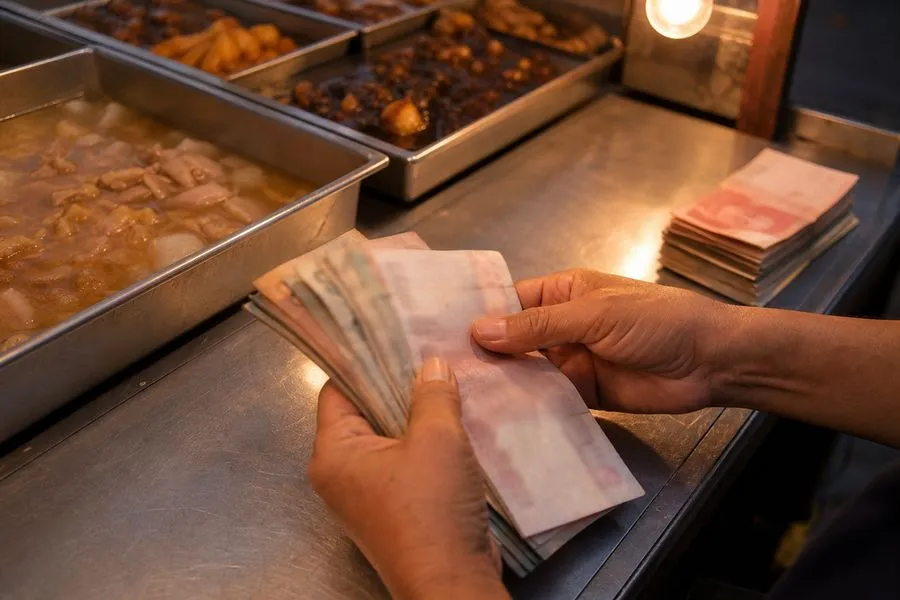
Cash matters here more than most budget pages admit.
Cash remains the most commonly used method with local vendors, in rural areas and at local markets, according to Wise's guide to paying in Thailand; cards are broadly accepted at hotels, malls and larger restaurants, but planning a card-only trip is not practical even in the tourist areas.
Which means your daily budget has a physical component - you need to be carrying it - and that changes how you draw it down.
Activities do not compress at all. A day with a paid excursion and a day without are different budgets, not different moods.
The one line item that moves your total most
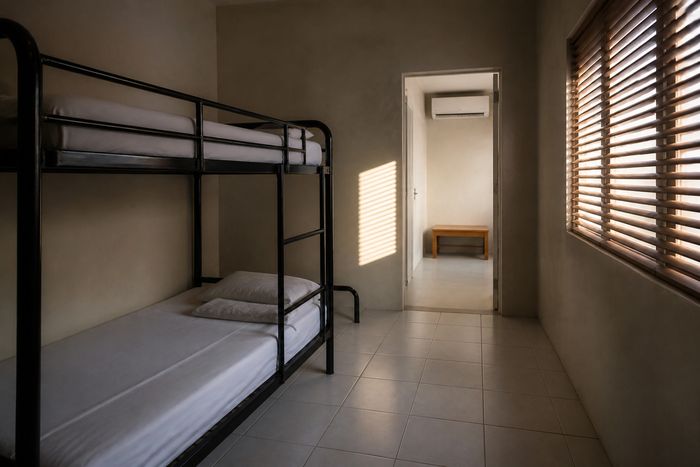
Accommodation. Not food, not transport, not the beers you are already worrying about.
The argument follows from the tier definitions rather than from a dollar delta I would have to invent: the items below lodging all compress toward street level. Food has a floor and a low ceiling if you eat where people who live there eat. Shared transport is priced the same for everyone.
Incidentals are small per instance.
Lodging does none of that - the gap between a dorm bed and a private air-conditioned room is a step, not a slope, and taking that step is the single decision that relocates you from the backpacker band into the mid-range one.
No source quantifies the step for me, and I am not going to pretend otherwise.
I got this exactly wrong on Ko Lanta. I had budgeted a stretch there at backpacker rates, confidently, with the food and transport lines worked out to the baht. Then I took a private room for the first few nights because I wanted to sleep, and never went back to a dorm.
Every saving I had planned downstream stopped mattering. Skipping restaurant dinners, walking instead of riding, buying breakfast from the shop on the corner - all of it, together, did not close the gap the room had opened. I had budgeted one tier and lived in another, and the line item that did it was the one I had treated as a detail.
Runner-up is activities, and the reason it is a runner-up rather than the winner is that it is lumpy. Lodging is every night; activities are some days. But when they hit, they hit harder than anything else on the page, and that is where published daily figures start actively lying to you.
What a "daily budget" figure quietly leaves out
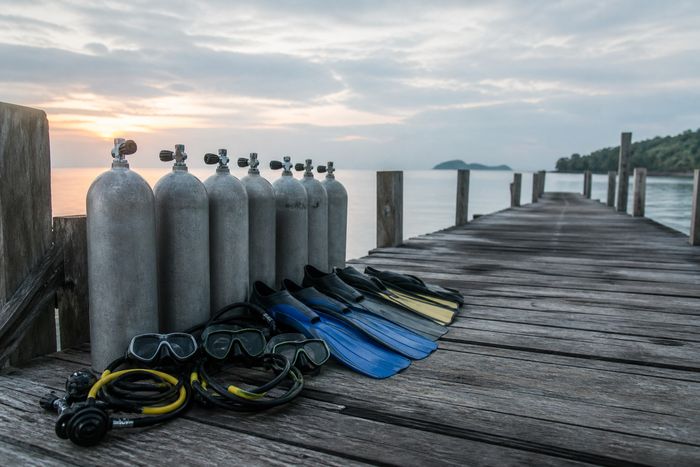
Diving and other multi-day courses. Internal flights. Rental deposits and gear.
Those exclusions are not my inference - the source figures state their own scope, and the big-ticket items are outside it. Your daily band covers a day of being there. It does not cover the things that make the trip worth being there for.
I learned this on an activity-heavy stretch that I had budgeted straight off a generic daily figure, because it was a number and I needed a number. One course fee consumed most of what I had planned for the week. Nothing about my day-to-day spending had changed; I ate the same food and took the same songthaews.
The daily figure was fine. The trip budget was in pieces, because the daily figure had never been asked to contain a four-figure baht course.
A smaller version, and the one that irritates me more: a cancelled Ko Tao boat left me stuck at the Chumphon pier for an unplanned night. One extra room, one extra day of meals, one extra transfer. No daily average contains a cancelled boat, and if your budget has no slack, weather is a financial event.
Then the two everyday items nobody enters. Alcohol is the first, and it sits well above the street-food baseline - a few drinks out can cost more than the day's food did. I could not find a dependable published figure for how big that gap is, and I would rather say that than hand you a made-up multiplier.
If you drink, add your own line and be generous with it.
Tipping and service charges are the second. I am flagging them as a forgotten line item only; the norms and the actual percentages live in tipping and bargaining norms that change your daily spend.
One more leak, on the mechanics side. Card and ATM fees are a real budget line, not a rounding error, and they compound quietly across a two-week trip. I am not printing figures for them here because they deserve their own treatment: see how to avoid ATM and card fees.
Last thing worth knowing before you book activities: bundled transport-plus-activity day packages generally cost more per person than arranging the same transport and entrance fees yourself. Direction only - no source I trust quantifies the gap, so treat it as a reason to price both, not as a percentage.
Build your own number: the daily budget calculator
The calculator does one thing the tables cannot: it uses your figures.
You pick a tier, enter your trip length in nights, and - this is the part that matters - you can enter your own nightly accommodation figure, which replaces the lodging component of the band rather than stacking on top of it.
One-off costs go in as separate toggles with your own amounts, and they stay on their own line instead of being smeared across a per-day average.
The output is a range for the whole trip, plus a one-off total shown separately, with the tier definition and the as-of date of the underlying figures printed beside it. Never a point estimate.
A personalized range built on a real quote from the booking page you will actually use beats a national average built out of someone else's trip, and a point estimate would just be a lie with better presentation.
Have these open before you start:
- Your real trip length in nights, not days - the nights are what you pay for.
- A nightly price from the booking site you will actually use, for your actual dates, at the room type your tier implies. Not an average, one real price.
- A written quote for any course, dive package or multi-day activity you already know you want.
- Whether any rental will need a deposit, and in what form - cash, card hold, or a passport, which is a separate argument entirely.
- Your planned cash-to-card mix, given that cash still dominates with local vendors, at markets and on shared transport.
- Today's exchange rate from a live source, checked today.
- A note of which of your costs are one-offs rather than daily, so you do not accidentally multiply an airport transfer by fourteen.
- A slack figure of your own choosing for weather, cancellations and the night you did not plan to spend in Chumphon.
Before you trust any of these figures, re-check these four things
Treat this as the routine you run on any travel-cost number, this page included.
- Find the date on the figure. Not the copyright year in the footer - the date attached to the number itself. If the methodology is undated, you do not know what year you are budgeting for. One of the six sources behind this article publishes no methodology date at all, which is why its band is dated as undated in the table rather than quietly assigned to 2026.
- Check whether it is single-sourced or corroborated, and who benefits. A band that appears in three unrelated places is worth more than a precise-looking figure that appears in one. Ask what the publisher sells. A tour operator's cost page and an independent traveler's cost page are not the same kind of document, even when they print the same number.
- Check the scope. Does the figure include or exclude courses, internal flights, deposits, gear and alcohol? Most exclude all of them, usually without saying so on the page where the number appears. A daily figure that includes activities and one that does not are not comparable, and the word "average" hides that difference perfectly.
- Convert at a same-day rate, and re-check before you book rather than before you leave. Any baht conversion printed alongside a USD figure is a snapshot of a rate that has since moved. Do the conversion yourself, on the day the money leaves your account.
The costs on this page are dated and they will drift.
That is why the page carries a visible last-reviewed date instead of pretending to be timeless, and why I would rather give you a method that survives 2027 than a figure that does not survive this year.
Frequently asked questions about a Thailand daily budget
How much money should I bring per day for a two-week trip? Pick a tier rather than a number: roughly $25-56 a day for a backpacker pattern, roughly $50-167 for mid-range, and roughly $150-400 for comfortable, all as of 2026 and all indicative. Run your actual night count through the calculator to get a range for the whole trip rather than multiplying a headline figure by fourteen. Remember the band covers daily spending only - no flights, no courses, no deposits.
Is $50 a day enough in Thailand? It depends on the pattern, and $50 is the worst possible test case because it sits above most backpacker estimates and below most mid-range ones. For dorm beds, street food, shared transport and few paid activities, it is comfortable. For a private air-conditioned room and a paid activity most days, it is not, and the two things most likely to break it are a course or dive package and any lodging above dorm level.
Backpacker vs mid-range: what's the actual price jump? There is no publishable dollar figure for it, because no source in the material splits a daily total by line item and tier. The jump is a shift in pattern, and it happens at accommodation - dorm bed to private air-conditioned room, with everything else following. The fact that $50 a day sits inside both published bands is itself the answer to how sharp the boundary is.
Why does every website give a different daily budget for Thailand? Because there is no standardized definition of the tiers, most methodologies are undated, and almost every figure comes from travel blogs, tour operators or crowdsourced data rather than official statistics.
No official Thai government or bank source publishes a daily-budget figure at all. The source box below shows exactly what these numbers rest on.
Does this budget include a diving course or a scooter rental deposit? No, and neither does almost any published daily figure you will find. Courses, multi-day activity fees, internal flights, deposits and gear are the classic budget-breakers for activity-heavy trips, and they sit outside the scope of every band on this page. The calculator lets you add them as one-offs so they show on their own line instead of distorting a per-day figure.
How will I know while I'm there whether my budget is actually holding? Compare your actual spend against your daily band every few days, not at the end of the trip when it is too late to adjust. Treat the first three days as calibration rather than as data, since arrival days skew high with transfers, a first-night room booked in a hurry and everything you forgot to pack.
Drift usually comes from fees and forgotten extras rather than from your food budget, so check both how to avoid ATM and card fees and tipping and bargaining norms that change your daily spend before you decide you have overspent.
Get your own range
Open the calculator, put in your nights and one real nightly price, and take the resulting range into your booking - not a single number, and not mine. If you want the rest of the picture, there is more on money and costs in Thailand.
Sources
All six sources below are travel-media or commercial publications. No official Thai government or bank source publishes a daily-budget figure, so nothing on this page carries official backing.
- visitthailandtoday.com, Thailand Travel Costs (2026 Edition) - https://www.visitthailandtoday.com/thailand-travel-costs - as of April 2026 - backpacker and mid-range daily bands.
- neverendingfootsteps.com, Cost of Travel in Thailand - https://www.neverendingfootsteps.com/cost-of-travel-thailand-budget - undated methodology - backpacker daily band.
- royalthailandtours.com, Thailand Travel Cost - https://royalthailandtours.com/thailand-travel-cost - 2026 - backpacker and mid-range daily bands.
- travelcostcalculator.org, Thailand - https://travelcostcalculator.org/cost/thailand - 2026 - mid-range daily band and the widely cited figure of about $64 a day.
- southeastasiasimplified.com, Thailand Travel Cost Breakdown 2026 - https://www.southeastasiasimplified.com/blog/planning-13/thailand-travel-cost-breakdown-2026-what-you-actually-spend-82 - 2026 - comfortable and luxury daily bands, including the high outlier.
- wise.com, Cash or card in Thailand - https://wise.com/gb/blog/cash-or-card-in-thailand - undated - cash dominance with local vendors and at local markets.
Every daily range on this page is indicative and dated 2026 source material, not a converged consensus: the published figures disagree because their authors use different tier definitions and mostly undated methodology. No band includes international or internal flights, courses and multi-day activity fees, rental deposits or gear purchases, and no exchange rate is printed here because all available rate data was an undated snapshot - convert at a same-day rate before you commit money.
