Box Jellyfish and Rip Currents in Thailand: Risk Guide
On this page
- Two hazards, two maps, two calendars
- Where box jellyfish are actually documented - and where people have actually been hurt
- Table 1: Region and season hazard picture
- Check your own region and month
- Vinegar is not universal - the first aid depends on what stung you
- Table 2: Marine sting first aid by species
- The sting response algorithm
- How many people box jellyfish have actually killed here
- Rip currents: the Phuket west coast, in numbers
- Reading the flags, and what an empty beach means
- Before you get in: the ten-second check
- Frequently asked questions
- Two things to do before your next swim
- Sources
Safety information last reviewed: 11 August 2026. If you are standing on a beach right now, the flags and the lifeguards in front of you outrank anything written on this page.
Ko Lanta, low season, a friend came out of the water at Khlong Khong with welts up her forearm, and somebody sprinted to the beach restaurant for the vinegar. I was the one who taught them to do that.
For about six years, "get the vinegar" was the entirety of my marine first aid, and I repeated it to every visitor who asked.
Then I read the actual protocols and found out that for one of the animals people get stung by in Thai water, vinegar is the wrong liquid and can make the pain worse.
Thailand has two water hazards worth planning around, and they share nothing.
Box jellyfish are biological, seasonal, and concentrated in a short list of named places; rip currents are physical, swell-driven, and concentrated in a different short list.
This page gives you a region-and-month picture of the documented risk with the strength of the evidence shown, first aid that splits by species, and the technique for getting out of a rip.
It does not give you an assurance that any beach is safe on any given day.
Two hazards, two maps, two calendars
The reason most beach-safety pages are useless is that they blend the two into one paragraph of "be careful in the sea." That sentence is the only one of its kind you will get from me.
Box jellyfish are documented on both Thai coasts, in the Tourism Authority of Thailand's own sighting zones, but the casualties cluster in a small Gulf group, and the risk rises in the second half of the calendar year.
Rip currents concentrate somewhere else entirely: Phuket's exposed west coast, at their strongest during the May-October Andaman monsoon, when the swell hits those beaches straight on. That is the only weather mechanics you need here.
The two hazards also differ in what you do about them. A sting is answered with a procedure, performed on sand, in the first five minutes, with equipment you can buy for 20 baht at a 7-Eleven. A rip current is answered earlier than that: by deciding not to go in, or by knowing what the water in front of you is doing before your feet leave the bottom.
There is no first aid for a rip. Once someone is offshore and panicking, the useful decisions have already been made or missed.
Where box jellyfish are actually documented - and where people have actually been hurt
Two lists exist, and almost nobody separates them. The first is where box jellyfish have been reported. The second is where people have been seriously hurt or killed.
They do not match, and confusing them will send you to the wrong island in the wrong month for the wrong reason.
TAT's sighting zones, published in August 2025, run down both coasts: Krabi, covering Ko Lanta and Hat Nopparat Thara / Mu Ko Phi Phi National Marine Park; Phuket, at Nam Bo Bay; Phetchaburi, meaning Hua Hin and Cha-am; Chumphon, meaning Ko Tao; Surat Thani, meaning Ko Samui and Ko Pha-ngan; and Trat, covering Ko Mak and Ko Kut. (The official documents and studies spell these "Koh" rather than "Ko." Same islands.)
Now the casualty list.
A peer-reviewed review of Thai hospital data by Thaikruea and Siriariyaporn found that Ko Pha-ngan and Ko Samui, both in Surat Thani, carry the greatest documented share of fatal and near-fatal cases in the country: three of the four documented fatalities happened there.
In that data set, covering 1998 to 2002, incidence peaked from August to October, overlapping high season and the full-moon-party crowds. That is a two-decade-old window, not a current-year statistic, and I would not present it as one.
A separate six-year field study at Ko Tao logged 170 box-jellyfish sightings and 81 Pelagia blooms, with both most abundant from July to December, and found precipitation and the lunar cycle to be the strongest predictors.
So one source peaks August to October and the other finds abundance elevated July to December. Those are different kinds of evidence, casualties versus sightings, and averaging them into a single tidy window would be inventing a fact. Treat the wider window as the planning one.
The season also moves with the weather. In October 2022, warnings were reportedly raised for Ko Samui and Ko Pha-ngan after a run of stings, some needing hospitalization and ventilator support, attributed to a monsoon season that ran long. Media-level reporting, not a study, but it fits the rainfall finding.
The detail from the hospital review that changed how I talk about this: warning signs near the full-moon-party area of Ko Pha-ngan read "bluebottles" when the actual hazard was box jellyfish. Two species groups. Opposite first aid.
If a posted sign in the worst-documented location in the country got the animal wrong, you cannot outsource identification to a sign, and you cannot outsource it to me either.
Table 1: Region and season hazard picture
| Region / island group | Box jellyfish: documented status | Highest-risk months | Rip-current exposure | Evidence strength |
|---|---|---|---|---|
| Ko Pha-ngan and Ko Samui (Surat Thani, Gulf) | Greatest documented share of fatal and near-fatal cases in Thailand; 3 of 4 documented fatalities; official sighting zone | Aug-Oct in the hospital data; an elevated-warning episode was reported in Oct 2022 | Exposed to Gulf storm swell in season; a shoreline-wide swimming ban was documented on 19 Feb 2026 | Strong: peer-reviewed hospital data plus the official sighting list |
| Ko Tao (Chumphon, Gulf) | Official sighting zone; 170 box-jellyfish sightings logged in a 6-year field study | Jul-Dec abundance peak; rainfall and lunar cycle the strongest predictors | Not separately documented in the sources used here | Strong: peer-reviewed field study plus the official sighting list |
| Phuket (Andaman) | Official sighting zone at Nam Bo Bay only; no fatal case documented here in these sources | Not separately established for jellyfish | Highest documented rip-current risk in the country: roughly 30-40 drowning deaths a year reported island-wide, concentrated on Karon, Kata, Kata Noi, Kamala, Surin, Laem Singh and Nai Harn, strongest May-Oct | Mixed: official sighting list is solid; the drowning toll comes from one outlet that reported it two different ways |
| Krabi, incl. Ko Lanta and Mu Ko Phi Phi (Andaman) | Official sighting zone; a Pelagia panopyra swarm incident near Ko Hong was reported in 2018 | Monsoon-linked swarms reported; Morbakka reported Apr-May on the Andaman coast | Exposed Andaman beaches during the May-Oct monsoon; not separately quantified | Medium to weak: the official list is solid, the incident detail rests on a single blog |
| Trat, incl. Ko Mak and Ko Kut (eastern Gulf) | Official sighting zone | No month-level data located | Not separately documented | Weak on detail: present in the official list, nothing further |
| Phetchaburi: Hua Hin and Cha-am (upper Gulf) | Official sighting zone | No month-level data located | Not separately documented | Weak on detail |
| Everywhere else on the Thai coast | Absence from the sighting list is not evidence of absence; box jellyfish are documented on both coasts, and the list records where sightings were reported, not where they are possible | Unknown | Rips occur at any exposed beach, flagged or not | Not established: treat as unknown, not as safe |
Read the last row before you read the rest: a beach that is not on this table is an unlisted beach, not a safe one.
Check your own region and month
Region and month risk lookup - returns two separate readings. It will never return a safety score or a "safe" result.
Vinegar is not universal - the first aid depends on what stung you
Back to Ko Lanta for a second, because that is where my own advice fell apart. What I had been telling people was a single instruction for a category of animals that need different treatment. Two of the things you can meet in Thai water need opposite handling on the one question everybody thinks is settled.
TAT's official protocol for a box-jellyfish sting is specific. Remove tentacles with tweezers, not bare hands. Pour vinegar over the site for at least 30 seconds to deactivate stinging cells that have not yet fired.
Get immediate medical attention for severe symptoms: severe pain, confusion, chest discomfort, difficulty breathing, a change in skin color. Start CPR if the person is unconscious.
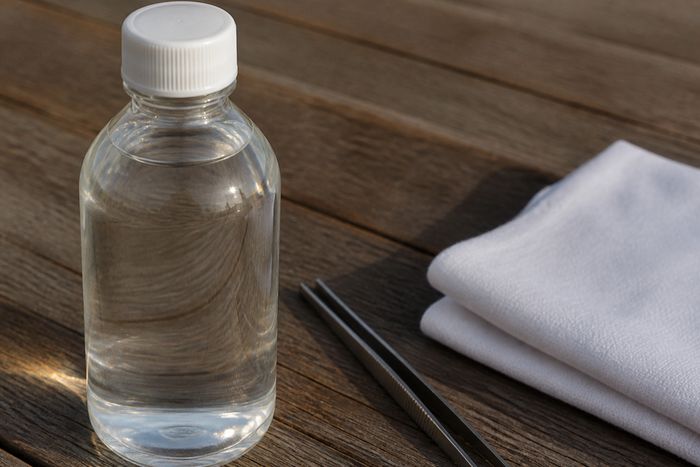
The mechanism, once, plainly: tentacle fragments left on the skin are loaded with stinging cells that have not discharged, and the wrong liquid makes them fire into you. That is why fresh water, alcohol, ice packs and urine are all on the never list, and why rubbing the area or pulling tentacles off with your fingers makes the injury worse rather than better.
Here is the split.
For Portuguese man-of-war, the bluebottle, healthdirect, the Australian government health service, says do not use vinegar, because it may increase pain.
Wash with sea water, remove the tentacles, then immerse the affected limb in hot water at roughly 45°C (113°F) for 20 minutes. That is Australian guidance for the same species group; I could not find a Thailand-specific protocol for this animal, and I am not going to pretend one exists.
A 2025 systematic review is reported to have found that effectiveness varies by species with no single protocol safe across all cnidarians. I have not read that review directly, only a commercial dive school's description of it, so take the principle rather than the citation.
The principle is corroborated by the two official sources above, which contradict each other on vinegar because they are describing different animals.
Table 2: Marine sting first aid by species
| What stung you | What to do | What to avoid | Source | Confidence |
|---|---|---|---|---|
| Box jellyfish (Chironex spp., the dangerous group) | Remove tentacles with tweezers, not bare hands; pour vinegar over the site for at least 30 seconds; seek medical attention for severe symptoms; CPR if unconscious | Fresh water, alcohol, ice packs, urine, bare-handed contact | TAT (official) and Healthline | High |
| Portuguese man-of-war / bluebottle (Physalia, not a true jellyfish) | Wash with sea water; remove tentacles; immerse the limb in hot water at about 45°C for 20 minutes | Vinegar: it may increase pain and can trigger further stinging-cell discharge | healthdirect, Australian Government (overseas authority for the same species group) | High, but the guidance is Australian; no Thailand-specific protocol for this species was located |
| Fire jellyfish (Morbakka fenneri), small and box-shaped, reported on the Andaman coast in Apr-May | Hot-water immersion at 42-45°C for 20 minutes reported as the main pain relief; vinegar considered safe | Not specified in the source | Commercial dive-school source | Low: single commercial source |
| Pink fire jellyfish (Pelagia panopyra), monsoon swarms | Vinegar was handed out by national park rangers in a reported 2018 incident near Ko Hong, Krabi; stings described as painful but not dangerous | Not specified in the source | Tourism blog | Low: single blog source, one reported incident |
First aid for a marine sting depends on the species. Vinegar is correct for the box-jellyfish group and is not recommended for Portuguese man-of-war. This page cannot identify the animal for you, and no single technique is safe for every marine sting.
The sting response algorithm
- Get the person out of the water and keep them still. Movement and panic circulate venom, and a thrashing casualty in waist-deep water is how you get a second one.
- Call 1669 immediately if there is any breathing difficulty, chest discomfort, confusion, altered consciousness or change in skin color. Do not wait to see whether it settles.
- Do not rinse with fresh water, alcohol, ice or urine. Do not rub the area, and do not pull tentacles off with bare hands.
- Look at what is on the skin and, if it is safe to do so, at what is in the water. A long-tentacled, near-transparent bell points to the box-jellyfish group. A bright purple balloon-like float, on the surface or lying on the sand, is a Portuguese man-of-war.
- If box jellyfish, or unknown, and vinegar is present: pour vinegar over the site for at least 30 seconds before touching anything, then lift the tentacles off with tweezers.
- If it is clearly a Portuguese man-of-war: no vinegar. Rinse with sea water, remove the tentacles, then immerse the limb in hot water at about 45°C for 20 minutes, as hot as the person can stand without scalding them.
- If the species is unknown and there is no vinegar: rinse with sea water only, lift the tentacles with tweezers, then go to hot-water immersion. This is the branch that does the least harm in either direction. It is not the ideal protocol, it is the defensible one when you do not know what you are looking at, which is most of the time.
- Start CPR if the person becomes unresponsive, and keep going until help arrives.
- Whatever the outcome, get the sting looked at if the pain persists or spreads, or if a mark blisters. For that part, see what to do if a sting or drowning incident needs medical care.
Step 7 is there because I have never once been on a beach where anybody knew which animal it was. An algorithm that assumes you will identify the species is not an algorithm you can use.
Jellyfish are not the only thing in the water: TAT's advisory also names the bluebottle, the blue dragon sea slug (which accumulates venom from the jellyfish it eats), stonefish, weever fish and sea urchins.
How many people box jellyfish have actually killed here
This is where I have to disappoint anyone who wants a number, because the sources give three, and they disagree.
The peer-reviewed hospital review counts at least four fatal and four near-fatal probable cases, and its own authors state that reporting is sparse and the true magnitude is likely underestimated. An unverified tourism blog says five confirmed deaths across 20 years, "probably more," plus 14 or more severe or near-death cases. A commercial dive-shop source says at least eight deaths since the 1990s.
None of those is current, and none is authoritative. The peer-reviewed figure is the best-sourced and also the one whose authors tell you it is too low. I am not going to average them, pick the scariest, or pick the most reassuring, because any single headline number here would be manufactured.
What the numbers do support is the part that matters for a trip: the documented incidents concentrate in one province and one broad season. A hazard with a known address and a known calendar is a hazard you can plan around, which is more useful than a body count.
Rip currents: the Phuket west coast, in numbers
Roughly 30 to 40 drowning deaths a year are reported on Phuket's beaches, with the large majority of victims international visitors and rip currents named as the primary cause. Treat that as an approximate reported range, not a figure.
The same outlet, Thai Examiner, reported it as "over 30 annually" in June 2025 and as "30 to 40 a year" in November 2025.
The wobble is part of the honest answer; there is no single official tally behind it that I could find.
The beaches reported to have the strongest rips are all on the exposed west coast: Karon, Kata, Kata Noi, Kamala, Surin, Laem Singh, Nai Harn. Karon has a long shore break and powerful rips. Calmer swimming is generally reported to be on the east and south coasts, though that comes from a commercial tour-safety source rather than an official one.
Two dated clusters give the reported pattern some weight.
Three tourists drowned at Karon Beach inside 18 days, reported on 30 June 2025, and three more drowning deaths across Phuket were reported on 4 November 2025 during what the outlet described as an extended rough-water season.
Those are documented events on documented dates. They are not an annual schedule, and November 2025 is exactly why I would not tell you the risk switches off on 31 October.
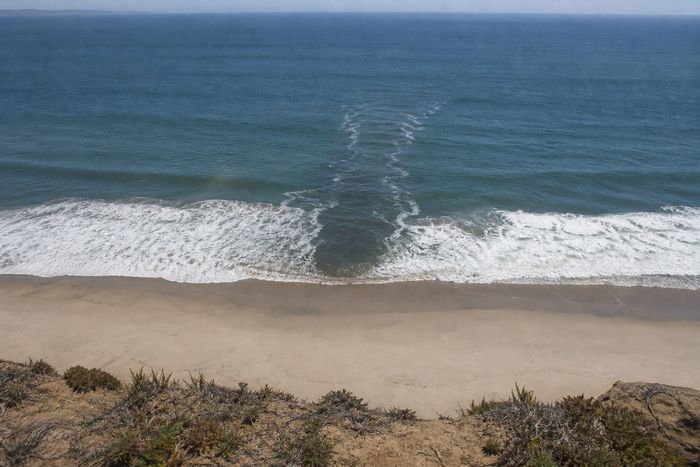
From the sand, a rip often looks like the good spot: a darker, flatter channel of water cutting seaward through an otherwise unbroken line of white breakers, sometimes with foam and sand streaming offshore along it.
The gap in the surf is the current.
The reported lifeguard guidance is to stay calm, not fight it, stay afloat, and swim sideways, parallel to shore, until you are out of it.
Swimming straight back at the beach is what exhausts people.
One dive-tour operator puts roughly 80% of dangerous or deadly beach rescues down to rip currents and says about 70% of people cannot spot one, with local currents around 5 mph, faster than anyone can outswim.
No study is cited for any of that, and it is worldwide rather than Thai, so I am flagging it as one operator's estimate and leaving the advice resting on the lifeguard guidance instead.
If it is someone else in trouble, do not swim out.
Untrained rescue attempts are a recognized cause of a second drowning, and the reporting on Karon makes the point in the worst possible way: some of the people who die are the ones who went in after somebody.
Call for the lifeguards, and throw something that floats.
Reading the flags, and what an empty beach means
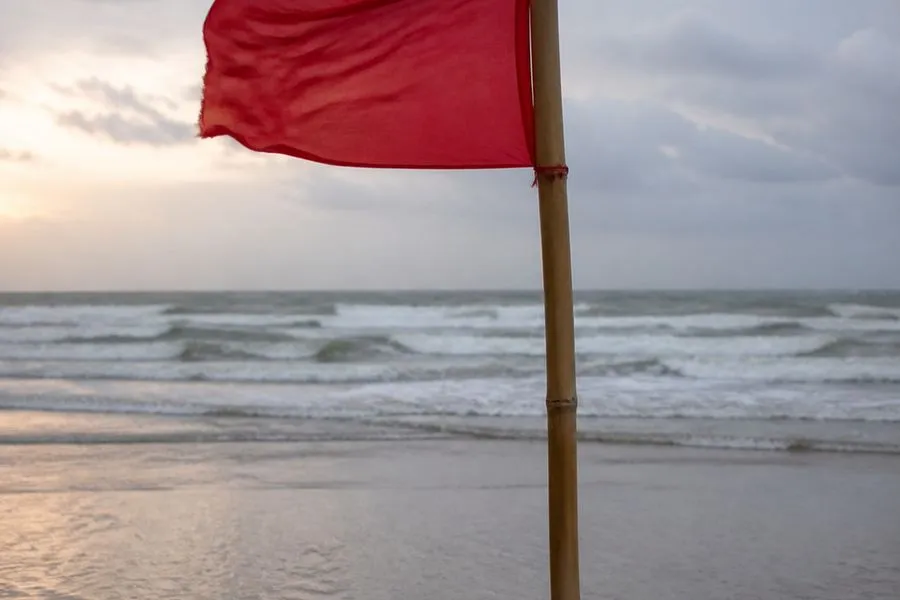
Red means the sea is dangerous and swimming is prohibited, usually because of strong rips or high surf. Yellow means caution, and entry is allowed with extra care. Red and yellow flown together mark the lifeguard-patrolled zone, which is where swimming is meant to happen.
As quoted in the Karon reporting: "Authorities emphasize that red flags are not suggestions. They signal real danger. When red flags fly, the sea should be avoided-no exceptions."
Now the part that makes flag literacy worth more than a sentence. The three people who drowned at Karon inside 18 days did so while red flags were flying. Knowing the color code is not the same as obeying it, and every year a share of the people who die on Phuket walked past the flag on their way in.
The system has real gaps, and you should know them before you rely on it.
Phuket's lifeguard service is reported to operate only while the red-and-yellow flags are up, roughly 09:00 to 18:00, but I could not confirm those hours from an official source, so take the general rule instead: patrol coverage is limited both in hours and in geography, not every Thai beach has a service at all, and rips occur on beaches where nothing is posted.
Flag-warning systems exist but are inconsistently enforced from beach to beach. No flag is not a safety rating; it usually means nobody is watching.
When the system does work, it works decisively.
On 19 February 2026, red flags went up along Ko Samui's major beaches, Chaweng and Lamai included, and swimming was banned along the entire shoreline, with strong winds and 1-2 m waves forecast to persist through 20-21 February.
That is what a real closure looks like: shoreline-wide, dated, and not negotiable.
Before you get in: the ten-second check
TAT's preventive guidance is unglamorous and free. Stay inside the buoy-marked safety zones. Avoid swimming after heavy rain, at night, or on unpatrolled stretches.
Wear protective swimwear: a rash guard, a lycra suit, long sleeves. Do not touch a beached or apparently dead jellyfish, because it can still sting.
The one piece of official advice almost nobody uses: Thai hotels, beachside restaurants and dive operators are required to keep vinegar on hand for stings, and visitors are advised to carry their own too.
A small bottle costs less than a bottle of water. I keep one and a pair of tweezers in the dry bag from July onward on the Gulf side, and I have twice ended up handing it to somebody else.
The check, in order:
- Look for flags before anything else. Red means out of the water, yellow means caution, red and yellow together marks the patrolled zone.
- No flags and no lifeguard? Treat the beach as unrated, not as safe.
- Check the month against table 1 for the region you are actually standing in, not the one you read about.
- Skip the swim after heavy rain, and skip it at night.
- Stay inside the buoy-marked safety zone where one exists.
- On a Gulf island between roughly July and December, wear a rash guard or lycra suit. It is the one measure that works whether or not you spot the animal.
- Ask the hotel, beach restaurant or dive operator where their vinegar is kept. They are required to have it, and knowing the location beforehand is worth more than knowing the protocol.
- Carry a small bottle of vinegar and a pair of tweezers in the beach bag if you are on an island in season.
- Do not touch a beached jellyfish, and keep children away from one. It stings after it dies.
The emergency ambulance number in Thailand is 1669. Call it for any sting with systemic symptoms, and for any drowning, before you start working out where to go.
Frequently asked questions
I got stung and there's no vinegar anywhere - what do I do? Rinse with sea water only, never fresh water, lift the tentacles off with tweezers rather than fingers, then move to hot-water immersion at about 45°C. Call 1669 the moment any systemic symptom appears. Hotels, beach restaurants and dive shops are required to keep vinegar, so ask before you improvise.
How do I know if a sting needs a hospital and not just first aid? Any of these means hospital, not first aid: breathing difficulty, chest discomfort, confusion, altered consciousness, change in skin color. Call 1669 immediately rather than waiting to see whether it settles. For what happens after that call, see what to do if a sting or drowning incident needs medical care.
There are no flags and no lifeguard on this beach - does that mean it's fine? No. Patrols cover limited hours and only some beaches, rip currents occur where no flag is posted, and flag systems are inconsistently enforced from beach to beach. An unflagged beach is unrated, not rated safe, and the specific patrol hours are not confirmed by any official source I found.
Can I still swim on Ko Pha-ngan or Ko Samui in October? Those two islands carry the greatest documented share of fatal and near-fatal box-jellyfish cases in Thailand, and August to October is the peak window in the hospital data. I would not tell you yes or no. If you swim, use the checklist above: rash guard, buoyed zone, vinegar located first.
My friend is caught in a rip - should I swim out to them? No. Untrained rescue attempts are a recognized cause of a second drowning. Call for lifeguards and throw anything that floats. Shout to your friend to stop fighting the current, stay afloat, and swim parallel to the shore rather than straight back at it.
Is Phuket actually dangerous to swim at, or is that overblown? Both. Roughly 30 to 40 drowning deaths a year are reported island-wide, mostly foreign visitors, but they concentrate on named exposed west-coast beaches during the May-October monsoon. That range comes from a single outlet that reported it two different ways within five months.
Two things to do before your next swim
Run your own region and month through the selector above, so you know which of the two hazards you are actually dealing with on your dates. Then, when you arrive, ask at reception or at the beach restaurant where the vinegar is kept. Those two take five minutes between them, and they are worth more than memorizing anything else here.
For the case where first aid is not enough, read what to do if a sting or drowning incident needs medical care.
While you are packing habits, there are other safety habits worth knowing before you go, and the rest of the category has more on staying safe and getting medical care in Thailand.
Safety information on this page last reviewed 11 August 2026. If you are at the water today, the flags and the local lifeguards override this page.
First aid for a marine sting depends on the species: vinegar is correct for the box-jellyfish group and is not recommended for Portuguese man-of-war, this page cannot identify the animal for you, and no single technique is safe for every marine sting.
Sources
- Tourism Authority of Thailand Newsroom, "Jellyfish safety advice in Thailand," 25 August 2025 (official). Sighting zones, box-jellyfish first-aid protocol, preventive guidance, vinegar-availability requirement, other venomous animals: https://www.tatnews.org/2025/08/jellyfish-safety-advice-in-thailand-what-tourists-should-know-before-swimming
- Thaikruea and Siriariyaporn, peer-reviewed review of Thai hospital data, 1998-2002. Surat Thani casualty concentration, August-October incidence peak, four fatal and four near-fatal cases with the authors' underestimation caveat, the "bluebottles" signage failure: https://pmc.ncbi.nlm.nih.gov/articles/PMC4756446
- Six-year field study of box jellyfish and Pelagia blooms at Ko Tao (peer-reviewed). The 170 sightings, 81 blooms, July-December abundance window, rainfall and lunar cycle as predictors: https://www.sciencedirect.com/science/article/abs/pii/S0272771424003809
- healthdirect, Australian Government (overseas health authority for the same species group). No-vinegar rule and 45°C hot-water immersion for Portuguese man-of-war: https://www.healthdirect.gov.au/jellyfish-stings
- Healthline, box jellyfish sting guidance. The never-use list (fresh water, alcohol, ice, urine) and the unfired stinging-cell mechanism behind it: https://www.healthline.com/health/box-jellyfish-sting
- Thai Examiner, 30 June 2025. Karon cluster of three drownings in 18 days, the "red flags are not suggestions" quotation, rip-escape technique, bystander-rescue warning: https://www.thaiexaminer.com/thai-news-foreigners/2025/06/30/third-loved-one-and-tourist-downed-off-karon-beach-in-dangerous-rip-tides-in-just-18-days-on-saturday
- Thai Examiner, 4 November 2025. Three further Phuket drowning deaths, the roughly 30-40 annual range, majority-foreign-visitor detail, and the outlet's own inconsistency with its June figure: https://www.thaiexaminer.com/thai-news-foreigners/2025/11/04/three-more-dead-as-phukets-beautiful-waters-and-shoreline-claims-more-lives-during-an-extended-season
- Beach and rip-current safety guide, Phuket tour-safety operator (commercial source). Flag-color system, reported lifeguard hours, exposed west-coast beach list: https://sgsphuket.com/blog/beach-rip-current-safety
- Khaosod English, 19 February 2026. The dated Ko Samui shoreline-wide swimming ban and red flags: https://www.khaosodenglish.com/news/2026/02/19/red-flags-raised-as-strong-winds-batter-samui
- Commercial dive-school article on species-dependent jellyfish first aid (commercial source). Morbakka fenneri entry, the "no single protocol for all cnidarians" principle as described, and the at-least-eight-deaths version of the disputed toll: https://www.siamdive.com/en/blogs/why-vinegar-fails-half-jellyfish-thai-waters
- Tourism blog on box jellyfish in Thailand (unverified source, used only where the text discusses weak or conflicting evidence). The 2018 Pelagia panopyra incident near Ko Hong and the five-deaths-in-20-years version of the disputed toll: https://iamkohchang.com/blog/box-jellyfish-in-thailand.html
This page is general safety information, not medical advice, and it does not replace assessment by a medical professional or by the lifeguards and local authorities in front of you on the day. Any envenomation with systemic symptoms is an emergency: call 1669 and get medical help rather than continuing first aid alone. The historical box-jellyfish casualty figures here conflict across three sources, none current or authoritative, and are presented as a disagreement rather than as one number. The sighting-zone list records where sightings were reported, not where the animals can occur, and flag and lifeguard coverage is limited in hours and geography and inconsistently enforced. Neither absence from a list nor absence of a flag is a safety rating.
