Train, Bus, Van, Ferry or Flight: How to Choose in Thailand
On this page
- Start With the Shape of the Leg, Not the Price
- The Five Modes, and What Each One Is Actually For
- Trains, buses, vans, ferries and flights: what each mode is actually for
- Pick Your Leg: A Decision Tree
- The Night Train Question
- Flying, and Why "Flights Are Always Pricier" Is Wrong
- Reaching an Island With No Airport
- One combination journey, annotated
- How Far Ahead to Book - and Where
- The One Seasonal Caveat This Page Will Give You
- Frequently Asked Questions
- Your Next Click
- Sources
Most legs in Thailand can be done four or five different ways, and the fare is the input that tells you the least about which one you should pick.
Start With the Shape of the Leg, Not the Price
I've booked the same route as a night train, a seat-sale flight and once, badly, as a minivan connection I'd assumed was a coach. What decided each of those wasn't the ticket price. It was four properties of the leg: how long it is, whether an overnight service exists on it, whether the last stretch is over water, and how much notice I had.
Get those four straight and the mode almost picks itself.
So name the shape first. Write it down if you have to: 700 kilometers overland, overnight option yes, no boat, three weeks' notice. That's a different animal from a 3-hour regional hop booked on a Tuesday for a Thursday.
Then fix two things before you open a single booking site: your budget tier and how much time you're willing to lose. Do it in that order and the comparison holds still. Do it the other way round and you'll rationalize your tier upward every time a mode looks inconvenient, which is how a 1,200 THB decision quietly becomes a 4,000 THB one.
What this page is not: a timetable, a live fare table, or a guide to any single route. Every number below carries a year, and the ones that come from commercial sources say so.
The Five Modes, and What Each One Is Actually For
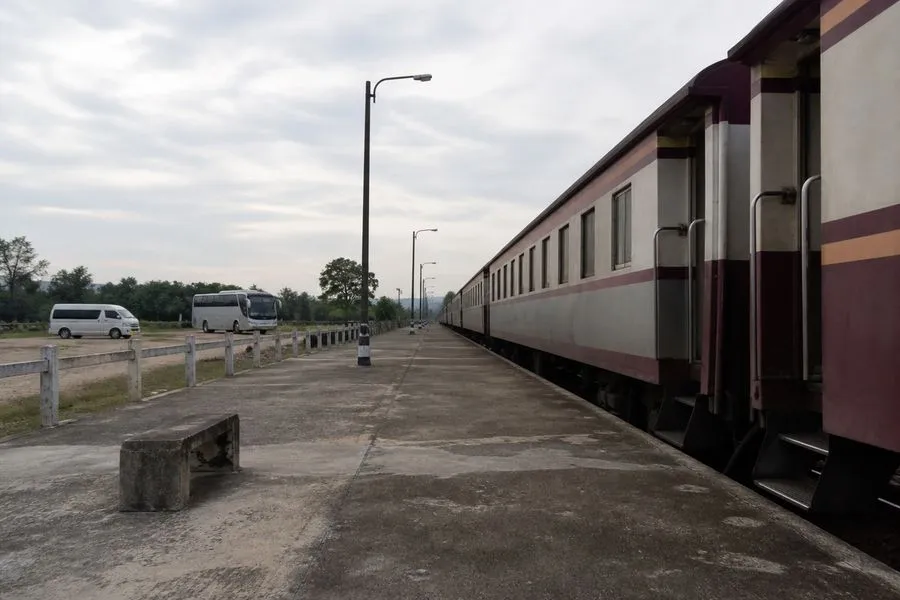
Long-distance rail. The State Railway of Thailand is the only long-distance rail operator in the country, which makes the comparison simple on the rail side: there is no second railway to shop against. What varies is class.
Seats at the bottom, open sleeper berths in the middle, private lockable cabins at the top. Book through the operator's own channel, railway.co.th and its D-Ticket system, and you're dealing with the inventory directly.
The full-size long-distance coach. State enterprise Transport Co., Ltd. - the baw kaw saw - runs alongside private operators including Nakhonchai Air, Green Bus and Sombat Tour. Here is the thing nobody tells you: "VIP bus" is operator marketing.
There's no single regulated comfort standard behind the label, so what it buys you shifts by operator and by route. Read the seat count, not the badge.
The rot tu minivan. Twelve to fifteen seats, air-conditioned, typically 2-5 hour regional and island-connection runs, according to commercial route listings.
The confusion is structural: they depart from formal terminals, from train stations, and from informal roadside pickup points, and which of those applies to your booking is not always printed anywhere you'd think to look.
Domestic air. Low-cost carriers are based at Don Mueang, full-service carriers at Suvarnabhumi. That's the general shape, not a rule you can book against.
Ferry and speedboat. This layer exists for one reason: several destinations have no airport. Nobody takes a boat in Thailand for the boat's sake.
Trains, buses, vans, ferries and flights: what each mode is actually for
| Mode | Approximate cost tier | Typical journey-time band | Overnight option | Booking lead time | Weather / seasonal dependency | Best for |
|---|---|---|---|---|---|---|
| Long-distance train | Mid; sleeper berths reported at roughly 850-3,250 THB on the northern overnight service across 2024-2026 commercial sources (illustrative) | Long, 8 hours and up on trunk routes | Yes, seats through open berths to private cabins | Up to about 180 days on many routes (reported); berths are the constrained inventory | Low | Long overland legs where you'd otherwise pay for a hotel night |
| Full-size long-distance coach | Lowest of the ground modes; no sourced figure printed here | Long, comparable to rail on the same corridor | Yes on some corridors | Days, more around holidays | Low | Comfort per baht on long overland legs; corridors rail doesn't serve |
| Rot tu minivan | Low; no sourced figure printed here | Short to medium, typically 2-5 hours (reported) | No | Often same-day on regional hops | Low overland; high where it feeds a boat | Frequency on regional legs and island feeder runs |
| Domestic flight (low-cost) | Conditional against rail: a 2025-2026 third-party snapshot reported fares from around 900 THB one-way on the busiest trunk routes, which lands inside the sleeper band rather than above it (illustrative) | 1-2 hours in the air, plus transfers at both ends | No | Cheapest in the promotional band; usually gone inside 7 days | Low | Trunk routes when the fare is in its promotional band |
| Domestic flight (full-service / near-monopoly island route) | Conditional and route-specific: the operating carrier's own site shows a promotional "from" fare of 2,500 THB one-way to Ko Samui, which is a floor and not a typical fare | Short in the air; no sea leg to build slack around | No | Rises steeply in the cool season, around big holidays, and inside the last week | Low | Island legs where an airport exists and you're buying the day back |
| Ferry / speedboat | Low to mid; Gulf short hops reported at 150-550 THB by vessel class, Phuket to Ko Phi Phi at roughly 400-600 THB by standard ferry against 800-1,200 THB by speedboat (illustrative, commercial sources) | 40 minutes to several hours | Rarely | Days in high season; often same-day off-peak | High - this is the mode a season can cancel | The final stretch to an island with no airport |
Read the table across a row, not down a column: the cost tier only means something next to the journey-time band and the seasonal exposure in the same row.
Where a cell says "reported" or "illustrative," the figure comes from a commercial listing or a third-party snapshot rather than an operator's dated fare page, and it's there to show you the size of the step between options, not to be the price you budget against.
Two cells deliberately carry no number at all - coach and minivan fares - because this research pass turned up no sourceable figure for them, and I'd rather leave a gap than invent a range. The air rows are worded conditionally on purpose: the ranking between air and rail flips with the promotional fare on your dates.
Pick Your Leg: A Decision Tree
Walk this in under a minute. Seven nodes, one output.
1. Does this leg end on an island with no airport? Yes → you're booking a combination, not a mode. Skip to Node 5. No → continue.
2. Is the leg long enough that an overnight service exists on it? Yes → the sleeper is competing for a night of accommodation as well as a seat. Compare it against a flight plus a hotel night, not against a flight alone. Then continue. No → continue.
3. How much notice do you have? More than a couple of weeks → the constrained inventory is still open to you (sleeper berths, holiday-period seats), and the ground modes are at their most competitive. Inside a week → the air fare has usually left its promotional band. Recheck the ranking instead of assuming it held.
4. Is the leg roughly 2-5 hours and regional? Yes → the minivan is the frequency play, the coach is the comfort play. Note as a stated unknown: this research pass found no minivan-specific safety dataset, so there's no verdict to give you here in either direction. No → coach or rail.
5. Combination legs: is a joint land-plus-sea ticket sold for this pairing? Yes → it's usually the more reliable product for the connection. No → book each leg separately and build slack between them.
6. Is any part of this leg over water? Yes → check the current season's status for that specific crossing close to your travel date, and have a fallback before you pay for anything non-refundable.
7. Output. One or two modes, ranked, with a one-line reason each.
Then confirm two things before booking: the current terminal or airport for the mode you picked, and the live fare on the operator's own channel.
Run Bangkok to Chiang Mai through it. Node 1: no island, continue. Node 2: yes, an overnight service exists, so the sleeper is bidding for a hotel night too and the comparison is train against flight-plus-a-night.
Node 3, with a month's notice: berths are still available, ground modes at their strongest. Node 4: the leg is nowhere near 2-5 hours, so coach or rail. Output: sleeper first if you value the night's accommodation and don't mind arriving tired, low-cost flight first if the fare is sitting in its promotional band and you want the day.
Two things to confirm, and one of them is which Bangkok airport the flight actually leaves from.
Ties happen, and a tie is real information: it means the two modes are close enough that preference decides, not arithmetic. When the tree gives you a low-confidence output - usually because a season or a fare you haven't checked is doing the work - treat it as a shortlist to verify, not an answer. And be clear about what the tree does not know.
It ranks modes against the shape of a leg. It has no idea what this week's fares are or whether a specific boat is sailing on Thursday.
The Night Train Question
Second class air-conditioned sleeper on the northern overnight service runs roughly 850-1,340 THB, depending on which source you read - and the sources, dated between 2024 and 2026, don't agree with each other.
First class air-conditioned is the wider spread: roughly 1,450-3,250 THB across those same commercial sources. That's the widest disagreement on this page, and I'm not going to average it into a tidy figure for you. No current authoritative fare table turned up in this research pass.
For a live number, go to the operator's own D-Ticket channel.
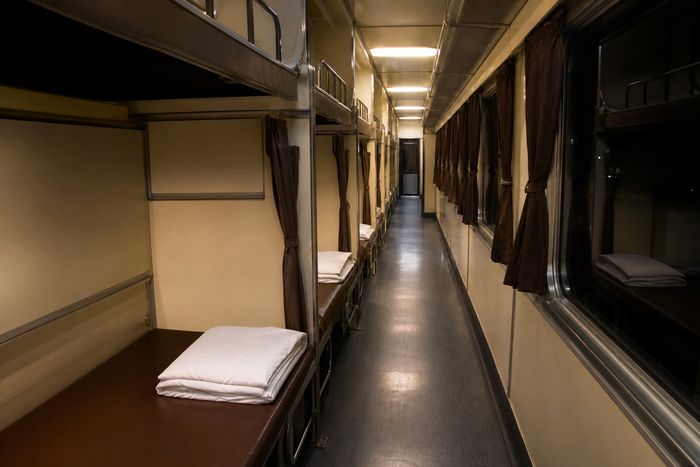
The class hierarchy, before the numbers mean anything. A seat is a seat, upright, all night. An open sleeper berth is a flat bed in a shared carriage with a curtain, the layout in the photo above.
First class is a private lockable cabin, two berths, a door. Each step up is a step in privacy more than a step in comfort - the mattress in second class is fine.
On the southern line to Surat Thani, which is the leg most Gulf-island itineraries actually need, second class air-conditioned sleeper is recorded at roughly 708-1,104 THB and first class air-conditioned sleeper at roughly 1,169-1,672 THB, as of 2024-2026 commercial sources.
Southern-line figures differ slightly between those sources, and I'm leaving the difference visible rather than picking a winner.
I've ridden the northern sleeper in every class it sells. Second class open berth is the one I kept booking: the curtain does most of the privacy work, and you're paying the smaller number. First class buys a door and a conversation you don't have to have with a stranger, which mattered to me exactly once, on a night I was traveling with a laptop I didn't want to sleep on top of.
The seat class I stopped booking after one attempt - I don't sleep sitting up, and arriving unslept costs you the morning you were trying to save.
Whether any of this beats a flight depends on a number I haven't given you yet.
Flying, and Why "Flights Are Always Pricier" Is Wrong
A 2025-2026 third-party snapshot reported low domestic fares on the busiest trunk routes, Bangkok to Chiang Mai and Bangkok to Phuket, from around 900 THB one-way. Read that against the sleeper band in the previous section. It sits inside it, not above it.
That figure is a blog snapshot rather than a live booking-engine reading, so treat it as an indication of where the floor can be, not as a price.
Now the other end of the range.
Bangkok to Ko Samui is a near-monopoly island route, and the operating carrier's own site shows a promotional "from" fare of 2,500 THB one-way. "From" is doing real work in that sentence: it's a floor.
According to a third-party analysis rather than anything the carrier publishes, the shape of that fare across the year is roughly this - a low off-peak floor, a substantial step up in the cool season, and something closer to double at the biggest holiday peaks.
Booking inside the last seven days removes the season from the equation entirely, because you're paying the late-booking fare whatever month it is.
Which is why I won't tell you flying is cheaper or pricier. The ranking flips with the promotional fare on your specific dates, and the only useful instruction is to check.
Two costs turn an air fare into something other than an air fare.
Low-cost carriers commonly include a smaller free checked-baggage allowance and sell the rest as a paid add-on, so the fare you compared is not the fare you'll pay if you're carrying a month's luggage.
And there's the transfer at both ends - time and money to reach the airport and to leave the other one, which a city-center rail terminal doesn't charge you.
One more thing, and only one sentence of it: which Bangkok airport a given low-cost domestic route departs from is a property of the route and the date rather than a fixed feature of the airline, so confirm it at time of booking - the case detail lives in which Bangkok airport or station you actually need.
Reaching an Island With No Airport
An island leg is two decisions wearing one ticket: a land mode, then a sea mode. Some pairings are sold as a single joint product, some you assemble yourself from separate tickets, and those are genuinely different things. The joint ticket is usually the more reliable of the two where the connection is concerned, because the connection is the operator's problem rather than yours.
Usually. Not a guarantee, and I've never seen one written as one.
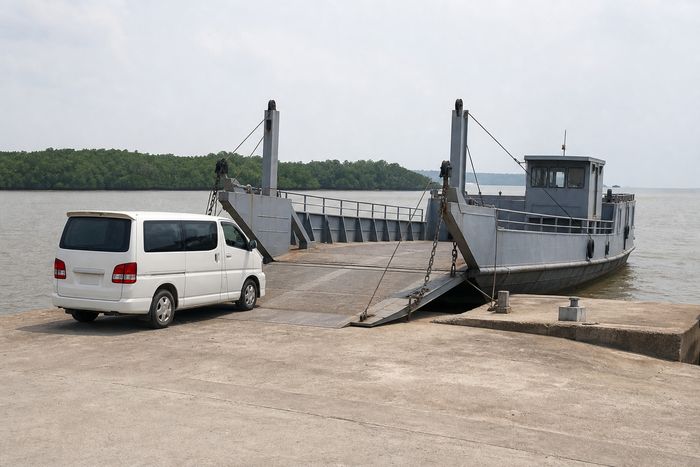
The sea leg fares that exist, all from commercial listings and all illustrative rather than current: Gulf short hops such as Ko Samui to Ko Pha Ngan reported at 150-550 THB depending on vessel class; Ko Tao to Ko Samui at roughly 500-900 THB by operator and class; the Andaman crossing from Phuket to Ko Phi Phi at roughly 400-600 THB by standard ferry against roughly 800-1,200 THB by speedboat.
That last pair is the useful one, because it shows you the size of the speedboat premium rather than any particular price.
Then there's the honest outlier. Satun Pakbara Speed Boat Club lists a Trang pier crossing to Ko Kradan at 600 THB one-way, about 40 minutes, two departures a day. That's a single named operator's own listing, and no Marine Department, provincial or port-authority source for Trang-area schedules or fares turned up even after a dedicated follow-up search.
Confirm it locally before you build a day around it.
Here's the structural point most comparison pages skip.
Some islands have a sheltered alternative crossing that keeps running when the exposed direct route doesn't - Ko Lanta's year-round vehicle ferry pattern is the example the research documents. "The ferry is down" and "the island is unreachable" are not the same statement, and knowing the difference is worth more than any fare on this page.
One combination journey, annotated
Bangkok to Ko Lanta. Two ends named, nothing in between - no times, no operator schedules, no connection windows.
- The leg splits. This is a land mode plus a sea mode, and you decide each one separately. Bundling them in your head is how people end up flying to save four hours and then discovering the boat only runs mornings.
- Choose the land mode on its own merits. Run it through Nodes 2, 3 and 4 above exactly as if no boat followed. Overnight service exists on this corridor, so the sleeper is bidding against a flight plus a hotel night. The boat doesn't change that arithmetic.
- Joint ticket or separate tickets. If a joint land-plus-sea product is sold for your pairing, it's usually the more reliable choice for the connection. If not, book each leg and build slack between them - real slack, not fifteen optimistic minutes.
- The season enters here, at the sea leg only. Your land mode doesn't care what month it is. Your crossing does. Check the current status for that specific crossing close to your travel date; the detail is in how island ferries change with the seasons.
- Know your sheltered alternative before you need it. Ko Lanta is the illustration: a vehicle ferry pattern that runs year-round while exposed crossings elsewhere don't. I have sat on a pier with a cancelled boat and no plan, which is a cheap lesson to learn secondhand and an expensive one to learn in person.
- Confirm before paying. Two checks: the departure point for the mode you picked, from the operator's own page, and the live fare from that same page. If either came from a blog, you haven't confirmed it.
Once you've settled on the mode, you still need the specifics for your exact pair of endpoints - departure points, current fares, the connection itself. That level of detail belongs to the route pages, which aren't published yet.
How Far Ahead to Book - and Where
Lead time first, because it's the part you can plan around. The operator's own rail reservation system takes bookings up to about 180 days ahead on many routes, according to secondary sources rather than an operator statement. Sleeper berths and holiday-period travel are the constrained inventory - that's where booking early actually buys you something.
Short regional minivan hops are the least constrained of anything on this page; I've walked up and bought a rot tu seat twenty minutes before it left more times than I've planned one.
Now the channel, which is the genuinely protective advice on this page. Book rail through a third-party reseller that isn't synced with the operator's own reservation system and what you're holding is a manually fulfilled request, not a confirmed seat.
This is a consistently reported pattern rather than a legal rule, but the reports line up: confirmation can take days, your class and berth selection aren't guaranteed, and the price is typically higher than the operator's own channel.
I recommended one of those sites to people for a while, on the strength of how convenient the checkout was, before I understood what I'd been recommending.
There's a naming problem layered on top. A private ticket agency can carry a domain and a brand very close to the national operator's, close enough that a hurried search puts you on the wrong one. Check you're on the operator's own site before you enter a card number.
A booking described as pending manual confirmation is not a booking.
The One Seasonal Caveat This Page Will Give You
Any leg with a sea crossing has a season, and the two Thai coasts don't share the same one - which means an itinerary combining a Gulf island and an Andaman island is exposed twice, differently. Suspensions are announced by individual operators close to the date.
There is no fixed government closure calendar; a search for an official advisory came up empty twice, and the closest official thing is a rolling shipping forecast rather than a schedule. The practical consequence for this page is that the mode ranking for an island leg can change completely because of the month, which is why Node 6 exists.
Everything past that - which coast, which months, what to do when a crossing is cancelled - is in how island ferries change with the seasons.
Frequently Asked Questions
Do I need to book transport in Thailand in advance? It depends on the mode and the calendar.
Sleeper berths and any travel over a holiday period are the constrained inventory and reward booking early on the operator's own channel, where the rail system takes reservations up to about 180 days ahead on many routes.
Short regional minivan hops rarely need advance booking at all.
Is it cheaper to fly or take the sleeper train? There's no single answer, and anyone giving you one is guessing.
Northern sleeper berths are reported at roughly 850-3,250 THB depending on class across 2024-2026 sources, while a 2025-2026 snapshot put low trunk-route air fares from around 900 THB - overlapping bands that reorder themselves with promotional fares.
Add the comparison people skip: the sleeper also replaces a hotel night.
Are minivans safe for long trips? This research pass found no minivan-specific safety or incident dataset, so I'm not going to manufacture a verdict.
What I can give you is the mode's profile: 12-15 air-conditioned seats, typically 2-5 hour regional routes, mixed formal and informal departure points. "I've heard they drive fast" is an impression, and it's still an impression when it's mine.
Why do sources disagree so much on sleeper-train fares? Because third-party fare tables go stale within months, and the snapshots in circulation are dated anywhere from 2024 to 2026. Nobody updates a blog post when a fare changes. Hence the rule this whole article runs on: a fare without a date is not a fare.
Take the live figure from the operator's own channel.
How do I know I actually picked the right one? Three checks, not a feeling.
Your fare and departure point came from the operator's own dated page rather than a blog; the season of any sea leg was checked close to your travel date rather than assumed from an older page; and you can name your fallback if the leg is disrupted.
Miss the third one and you're relying on luck.
Your Next Click
You have a mode for this leg. If you skipped the decision tree, run your actual leg through it - it takes under a minute and it catches the overnight-versus-hotel-night comparison most people never make.
Then do the one confirmation your result calls for: a Bangkok departure means checking which Bangkok airport or station you actually need, and anything over water means checking how island ferries change with the seasons.
Once you're on the ground at the other end, that's getting around once you've landed. Everything else in this series sits in the full guide to getting around Thailand.
Sources
- State Railway of Thailand, official booking channel (railway.co.th / D-Ticket) - sole long-distance rail operator; the instruction to take live fares and the booking window from the operator's own channel. Referenced via seat61.com; undated in this research.
- thailandtrains.com, Bangkok-Chiang Mai and Bangkok-Surat Thani ticket pages - the northern and southern sleeper fare bands. 2024-2026 snapshots, commercial tier, illustrative only.
- AirAsia Newsroom, carrier release on the Q2 2026 capacity reduction and dual-hub operation - the point that a Bangkok departure airport is a property of the route and the date, not the airline. As of 28 April 2026.
- Nation Thailand, reporting on the temporary consolidation of all nine Suvarnabhumi domestic routes - the dated instance behind that same point (15 July to 30 September 2026, resuming 1 October 2026). As of 28 July 2026.
- Bangkok Airways official site - the promotional "from" fare on the near-monopoly island route, cited as a promotional floor rather than a typical fare. Undated in this research.
- Don Mueang Airport (Airports of Thailand), airline information page - which carriers are based at the budget/domestic hub, and the instruction to confirm terminal and check-in assignment on the airport's own page. Summer 2026 schedule, 29 March to 24 October 2026.
- Commercial ferry-fare aggregators and operator listings (illustrative tier) - every ferry and speedboat range above, including the single-operator Trang figure. Undated in this research. No official Marine Department, provincial or port-authority source for these legs was found even after a dedicated follow-up search, and I'd rather say that than present a commercial schedule as authoritative.
Last checked: 11 August 2026. Every fare, journey time and terminal assignment on this page is dated and volatile - fares in Thailand go stale within months, sources dated 2024-2026 disagree with each other on nearly every route, and departure points for a given service change without notice. Ranges drawn from commercial aggregators, operator listings and third-party snapshots are illustrative and are not current prices. Confirm the fare and the departure point on the operator's own channel before you book, and confirm the status of any sea crossing close to your travel date. This page ranks modes by the shape of a leg; it is not a timetable, it does not guarantee any connection, and no joint ticket described here is proof against disruption.
